Freelancing & Remote Work with AI Course in Kenya
Get unlimited access to all learning content and premium assets Membership Pro
Freelancing & Remote Work with AI Course in Kenya
Learn Freelancing, Find Clients, Work Remotely & Use AI to Deliver Professional Services
Want to start freelancing in Kenya, find remote-work opportunities, work with local or international clients, or use Artificial Intelligence to turn your existing skills into marketable services?
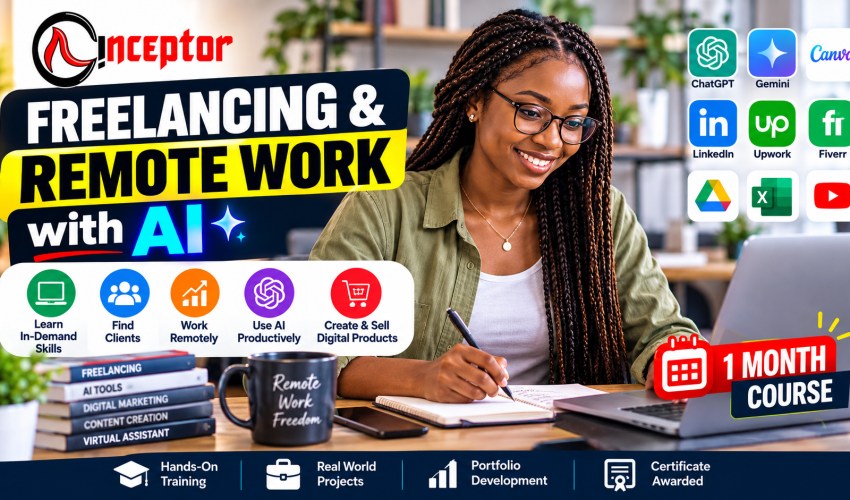
The Freelancing & Remote Work with AI Course at Inceptor Institute of Technology is a practical 1-month training program designed to help beginners develop the skills, workflows, portfolio evidence and client-acquisition capabilities needed to pursue modern freelance and remote-work opportunities.
This is not simply a course about opening an Upwork or Fiverr account.
You learn the complete process:
IDENTIFY A SKILL → PACKAGE A SERVICE → USE AI → PRACTISE → BUILD EVIDENCE → FIND OPPORTUNITIES → PITCH → DELIVER → GROW
You will also learn how skills and professional knowledge can be converted into digital knowledge products such as guides, templates, checklists, prompt packs, spreadsheets and practical toolkits that can be sold through digital marketplaces such as Vezill.
Course at a Glance
Course: Freelancing & Remote Work with AI
Training Provider: Inceptor Institute of Technology
Duration: 1 Month
Course Fee: KSh 15,000
Level: Beginner to Practical/Client-Ready
Training: Physical Classroom | Instructor-Led Online | Self-Paced AI Tutorial-Enabled Course Book
Training Model: Comprehensive Hands-On Training + Practical Real-World Projects + Portfolio Development
Certificate: Inceptor Certificate awarded subject to successful completion of applicable assessment/project requirements
Quick Answer: What Is the Freelancing & Remote Work with AI Course?
The Freelancing & Remote Work with AI Course at Inceptor Institute of Technology is a 1-month practical course in Kenya that teaches learners how to identify marketable skills, package freelance services, use AI tools such as ChatGPT to improve productivity, build a portfolio, approach clients, use freelance platforms and prepare for remote-work opportunities.
The course goes beyond learning theory.
You progressively create evidence of your abilities through practical assignments, simulated client work and a final freelance-business project.
The objective is:
DON’T JUST LEARN → PRODUCE EVIDENCE
What Is Freelancing?
Freelancing means providing a skill or professional service to clients without necessarily being employed permanently by one organisation.
For example, a business might need someone to:
- Research potential customers
- Write website content
- Manage social media
- Create presentations
- Design graphics
- Organise spreadsheets
- Respond to customers
- Perform administrative work
- Generate leads
- Create reports
- Write procedures and SOPs
- Assist with digital marketing
Instead of employing a full-time person, the business may contract a freelancer to complete the work.
The freelancer provides the agreed service and is compensated according to the terms agreed with the client or platform.
What Is Remote Work?
Remote work means performing your work away from the employer’s or client’s physical office using digital communication and collaboration tools.
A remote worker may be:
An employee working for an organisation remotely.
A contractor engaged for a specified period or project.
A freelancer providing services to multiple clients.
That means:
Freelancing is a way of working or doing business.
Remote work describes where the work is performed.
A freelancer can work remotely, but not every remote worker is a freelancer.
This course prepares you to understand and explore both pathways.
What Is Freelancing With AI?
Freelancing with AI means combining your own professional skills and judgement with Artificial Intelligence tools to perform appropriate parts of freelance work more efficiently.
For example, AI may help a freelancer:
- Research a topic
- Brainstorm ideas
- Analyse a client brief
- Draft content
- Improve an email
- Summarise information
- Generate content ideas
- Organise information
- Develop a presentation structure
- Create a first draft of an SOP
- Analyse basic data
- Generate marketing ideas
- Repurpose content
- Prepare proposal drafts
- Develop customer-support responses
But professional freelancing is not copying whatever AI generates and sending it to a client.
You will learn the professional workflow:
UNDERSTAND → PLAN → PROMPT → GENERATE → VERIFY → EDIT → DELIVER
The human freelancer remains responsible for understanding the client’s problem, checking facts, protecting confidential information, applying professional judgement, maintaining originality and delivering work that meets the client’s requirements.
That is the difference between merely knowing how to prompt AI and knowing how to use AI professionally.
Why Learn Freelancing With AI?
AI is becoming part of modern knowledge work.
A writer can use AI for research and ideation.
A Virtual Assistant can use AI to draft emails, organise information and create procedures.
A digital marketer can use AI for market research, content ideation and campaign development.
A researcher can use AI to help organise and analyse information.
A customer-support professional can use AI to draft and improve responses.
An entrepreneur can use AI to create systems, documents and marketing materials.
The useful combination is:
HUMAN SKILL + AI + QUALITY CONTROL = CLIENT VALUE
Inceptor’s approach therefore teaches both the underlying freelance skill and how AI can support the workflow.
What Will You Learn?
The course is organised around four practical stages:
Week 1: Understand freelancing, remote work and your marketable skills.
Week 2: Learn how to use AI to perform professional freelance tasks.
Week 3: Build your portfolio, service offers and client-acquisition system.
Week 4: Prepare for freelance/remote opportunities and learn how to turn knowledge into digital products.
WEEK 1: Freelancing & Remote Work Foundations
From “What Can I Do?” to “What Problem Can I Solve?”
Many beginners start with the wrong question:
“Which online job can I do?”
A more useful question is:
“What useful problem can I solve for another person or business?”
During Week 1, you will learn how the freelance economy works and identify skills you can develop, package and offer.
Topics Covered
- What freelancing is
- How freelancing works
- Freelancing vs employment
- Freelancing vs remote employment
- Freelancers vs independent contractors
- How businesses hire freelancers
- Understanding client problems
- Service-based freelancing
- Project-based freelancing
- Identifying your existing skills
- Identifying transferable skills
- Selecting marketable services
- Choosing a freelance niche
- Identifying your ideal customer
- Understanding local and international clients
- Introduction to freelance marketplaces
- Introduction to remote-work platforms
- Professional online communication
- Remote-work etiquette
- Productivity
- Time management
- Working independently
- Introduction to AI for freelancers
- Responsible AI use
- Confidentiality and client information
- Avoiding common online-work scams
Practical Project: Your Freelance Career & Skills Map
You will identify:
Skills You Have → Problems You Can Solve → Potential Customers → Services You Could Offer → Skills You Need to Improve
By the end of this exercise, you should have a clearer direction rather than randomly applying for every online opportunity you find.
WEEK 2: Using AI to Deliver Freelance Services
Turn AI Into a Professional Productivity Assistant
Knowing ChatGPT exists is not a freelance skill.
The value comes from knowing how to combine AI with a useful professional capability.
During Week 2, you learn practical AI-assisted workflows that can support different freelance services.
AI-Assisted Research
Learn how to use AI to:
- Structure research
- Develop research questions
- Analyse information
- Identify information gaps
- Summarise findings
- Organise research
- Develop reports
You will also learn why AI-generated information must be verified.
AI-Assisted Writing & Editing
Learn workflows for:
- Articles
- Website content
- Business documents
- Product descriptions
- Social media content
- Reports
- Editing
- Proofreading
- Rewriting
- Content repurposing
AI for Virtual Assistance
Explore workflows involving:
- Professional email
- Calendar planning
- Meeting preparation
- Meeting summaries
- Research
- Administrative documents
- SOPs
- Customer communication
- Data organisation
AI for Customer Support
Practise:
- Customer-response drafting
- FAQ development
- Response templates
- Knowledge-base content
- Complaint-response workflows
- Tone adaptation
AI for Digital Marketing
Explore:
- Audience research
- Competitor research
- Content ideas
- Social media calendars
- SEO content planning
- Advertising ideas
- Marketing copy
- Email marketing
- Campaign planning
AI for Business Documents
Use AI appropriately to assist with:
- Presentations
- Reports
- Proposals
- Standard operating procedures
- Checklists
- Templates
- Research briefs
AI + Spreadsheet & Data Tasks
Learn how AI can assist with:
- Organising data
- Understanding formulas
- Data-cleaning guidance
- Basic analysis
- Summarising findings
- Developing reports
The Professional AI Workflow
For selected assignments, document:
TASK → AI TOOL → PROMPT → INITIAL OUTPUT → VERIFICATION → HUMAN CORRECTION → FINAL OUTPUT
This demonstrates that you understand how to use AI as an assistant rather than blindly relying on generated output.
Practical Project: Simulated Client Tasks
Complete several realistic client assignments using AI-assisted workflows.
The objective is to produce work that can become part of your developing portfolio.
WEEK 3: How to Find Freelance Clients & Build Your Freelance Business
Having a skill is only one side of freelancing.
You also need to answer:
Who needs this skill?
What problem am I solving?
How will they find me?
Why should they trust me?
What evidence can I show them?
Week 3 focuses on moving from possessing a skill to presenting and marketing that skill professionally.
Choosing Your Freelance Services
Instead of saying:
“I can do anything online.”
You learn to develop a clearer service offer.
For example:
Broad skill: Writing
Possible service: SEO blog writing for small businesses
Or:
Broad skill: Administration
Possible service: Remote administrative and Virtual Assistant support for consultants.
Or:
Broad skill: Social media
Possible service: Social media content planning and management for small businesses.
A clearer service makes it easier for potential clients to understand what you can do for them.
How to Create a Freelance Portfolio Without Previous Clients
One of the biggest problems beginners face is:
“How do I get experience when clients want someone with experience?”
A practical solution is to build simulated portfolio projects.
If you want to provide social media services, create a sample content plan.
If you want to become a Virtual Assistant, create sample administrative workflows.
If you want to provide research services, develop a professional research brief.
If you want to write content, create relevant writing samples.
If you want to offer presentation design, create sample presentations.
Your portfolio should demonstrate:
“THIS IS WHAT I CAN DO.”
Throughout the course, you progressively create evidence instead of waiting until graduation to start building a portfolio.
Creating Your Freelance Profile
Learn how to create a professional profile that communicates:
- Who you help
- The problem you solve
- Your skills
- Your services
- Relevant tools
- Your experience
- Your portfolio
- Your value proposition
- Your professional credibility
Freelance Platforms
The course introduces learners to major freelance and professional platforms such as:
- Upwork
- Fiverr
- Contra
- Relevant remote-work platforms
You will learn how these platforms generally work, how clients evaluate freelancers and how to present yourself professionally.
Platform availability, fees, competition, eligibility requirements and policies can change. Training therefore focuses on transferable client-acquisition skills rather than dependence on one website.
Writing Freelance Proposals
A strong proposal should not simply say:
“Please give me this job. I am hardworking.”
Learn how to structure a proposal around:
CLIENT NEED → YOUR UNDERSTANDING → PROPOSED SOLUTION → RELEVANT EVIDENCE → NEXT STEP
You will practise:
- Reading job descriptions
- Identifying the actual problem
- Writing customised proposals
- Avoiding generic applications
- Selecting relevant portfolio evidence
- Communicating professionally
- Asking useful questions
- Following up appropriately
Finding Clients Outside Freelance Platforms
Freelance marketplaces are only one client-acquisition channel.
Explore additional approaches including:
- Professional networking
- Referrals
- Direct outreach
- Existing professional networks
- Local businesses
- Personal branding
- Content marketing
- Communities
- Previous professional relationships
The objective is to understand client acquisition, not merely one platform.
Client Communication & Project Management
Learn practical concepts involving:
- Client discovery
- Discovery calls
- Understanding requirements
- Client onboarding
- Defining deliverables
- Scope management
- Setting expectations
- Deadlines
- Revisions
- Professional communication
- Basic invoicing concepts
- Handling feedback
- Client retention
- Requesting testimonials
- Repeat business
Protect Yourself From Freelancing & Remote-Job Scams
Beginners looking for online opportunities can encounter fake jobs and dishonest clients.
Learn to recognise warning signs such as:
- Unrealistic income promises
- Requests for inappropriate upfront payments
- Suspicious links
- Requests for sensitive credentials
- Unclear job descriptions
- Attempts to bypass appropriate platform protections
- Fake recruitment processes
- Requests involving questionable financial transactions
A legitimate remote career requires both opportunity awareness and digital safety.
Practical Project: Freelance Client Acquisition Kit
By the end of Week 3, develop your own:
Freelancer Profile + Service Offer + Portfolio Samples + Proposal Template + Outreach Messages + Client Acquisition Plan
WEEK 4: Remote Career, Freelance Business & Digital Knowledge Products
Week 4 brings the pieces together.
Explore how the same digital skills can create several possible pathways.
Path 1: Freelancing
Offer services to clients on a project, hourly or contractual basis.
Path 2: Remote Employment
Use your digital, communication, AI and remote-collaboration skills when applying for suitable remote positions.
Path 3: Contract Work
Provide defined services to an organisation for an agreed period or project.
Path 4: Build a Specialized Freelance Business
Develop deeper expertise in a particular service and market it to a defined type of customer.
Path 5: Create Digital Knowledge Products
Turn useful knowledge into reusable digital assets.
What Can You Do After the Freelancing & Remote Work with AI Course?
The skills developed can support exploration of several career and freelance pathways.
Freelance Virtual Assistant
Support businesses and professionals with research, communication, scheduling, documentation and administrative tasks.
AI can assist with: drafting, research, summaries, organisation and SOP creation.
Portfolio evidence: administrative workflow, research brief, email samples and SOP.
AI-Assisted Virtual Assistant
Combine conventional VA skills with responsible AI workflows to perform appropriate administrative and knowledge-work tasks more efficiently.
Content Writer
Create articles, website copy, product descriptions and other business content.
AI can assist with: research, outlining, brainstorming and editing.
Portfolio evidence: polished writing samples.
Content Editor
Review and improve clarity, structure, grammar, consistency and tone.
Social Media Assistant
Help businesses research, plan and prepare social media content.
Portfolio evidence: content calendar and sample campaign.
Social Media Manager
Develop and manage broader social media strategies, content workflows and reporting.
Digital Marketing Freelancer
Support businesses with activities such as content, SEO, email, social media and campaign execution based on your level of specialist training.
SEO Assistant
Assist with keyword research, content briefs, on-page optimisation and related SEO tasks.
Online Research Assistant
Collect, verify, organise and present information for businesses, consultants, researchers and other professionals.
Customer Support Representative
Assist customers through appropriate digital communication channels.
Remote Administrative Assistant
Provide administrative support to organisations or professionals from a remote location.
Lead Generation Assistant
Research and organise potential customer/prospect information using legitimate and compliant methods.
E-commerce Assistant
Support online businesses with product information, customer service, research and other operational tasks.
AI Productivity Assistant
Help appropriate users integrate AI into repeatable workflows, documentation and productivity processes where your competence supports the service.
Presentation Designer
Turn information into structured business, training or marketing presentations.
Freelance Graphic Designer
Create visual assets where you possess the necessary design competence.
Project or Operations Assistant
Help teams coordinate tasks, documentation, schedules and operational information.
Content Repurposing Specialist
Transform existing source material into appropriate formats for different channels while maintaining accuracy and rights compliance.
Digital Product Creator
Turn original knowledge or skills into downloadable products.
Knowledge Product Creator
Research, structure and package useful expertise into practical learning resources.
Freelance Consultant
Professionals with genuine expertise can package that expertise into consulting services rather than starting from an unrelated skill.
Beyond Freelancing: Turn What You Know Into Digital Products
Freelancing normally involves performing work for a specific client.
But some knowledge can be packaged once and delivered repeatedly as a digital product.
This creates another potential opportunity:
KNOW → STRUCTURE → PACKAGE → PUBLISH → MARKET → SELL
For example:
A Virtual Assistant could create:
- SOP templates
- Client onboarding checklists
- Administrative templates
- Productivity guides
A Social Media Freelancer could create:
- Content calendars
- Caption frameworks
- Social media checklists
- Campaign planners
A Business Professional could create:
- Business spreadsheets
- Calculators
- Checklists
- Templates
- Practical guides
A Job/Career Specialist could create:
- Interview preparation resources
- CV templates
- Career workbooks
- Job-search checklists
A Digital Marketer could create:
- Marketing templates
- Campaign checklists
- SEO worksheets
- Prompt packs
- Content-planning systems
Other knowledge-product formats can include:
- How-to guides
- Templates
- Spreadsheets
- Calculators
- Prompt packs
- SOPs
- Tutorials
- Toolkits
- Mini-courses
- Workbooks
- Practical playbooks
Create & Sell Knowledge Products Through Vezill
Vezill is a digital knowledge marketplace that can provide one potential channel for distributing eligible digital knowledge products.
The basic model is:
KNOW SOMETHING USEFUL → PACKAGE IT → PUBLISH IT → HELP SOMEONE APPLY IT
For example, instead of repeatedly explaining the same process to different people, a knowledgeable creator may package the process into a structured guide, checklist, template or toolkit.
Learners interested in knowledge entrepreneurship can therefore explore two related models:
SERVICE MODEL: Solve a client’s problem directly.
KNOWLEDGE PRODUCT MODEL: Package useful know-how into a reusable digital resource.
Creators remain responsible for the accuracy and originality of their products, intellectual-property rights, lawful use of AI-generated material and compliance with applicable marketplace terms.
Sales are not guaranteed simply because a product has been published.
Build a Portfolio — Not Just a Certificate
One of the strongest principles of this course is:
DON’T JUST LEARN → PRODUCE EVIDENCE
A certificate tells someone you completed training.
A portfolio can show what you are capable of producing.
Throughout the month, your potential evidence may include:
- Freelancer profile
- Service description
- AI-assisted research brief
- Professional email samples
- Content sample
- Customer-support workflow
- Social media content plan
- Spreadsheet/data exercise
- Standard Operating Procedure
- Freelance proposal
- Client onboarding document
- AI workflow documentation
- Digital-product concept
- Final capstone project
This can be especially valuable for beginners who do not yet have extensive paid-client experience.
Final Capstone: AI-Powered Freelance Business Launch Project
At the end of the course, bring your learning together into a practical capstone project.
You will:
- Select a viable freelance niche.
- Define your target customer.
- Identify a problem that customer needs solved.
- Develop a professional service offer.
- Create relevant portfolio evidence.
- Develop your freelancer profile.
- Prepare proposal templates.
- Demonstrate responsible AI-assisted delivery.
- Develop a client-acquisition plan.
- Complete a simulated client assignment.
- Present the final deliverable.
- Document the AI tools and prompts used where appropriate.
- Verify and improve AI-generated work.
- Develop one small digital/knowledge-product concept based on your skills or expertise.
The objective is to move from:
LEARNING → EXECUTION → EVIDENCE
Tools You May Encounter During Training
Depending on the particular task and current availability, learners may encounter tools and platforms such as:
AI: ChatGPT, Claude, Gemini and related AI productivity tools.
Productivity: Google Workspace and Microsoft productivity applications.
Design: Canva and other appropriate creative tools.
Professional networking: LinkedIn.
Freelancing: Upwork, Fiverr, Contra and other relevant marketplaces.
Remote work: collaboration, project-management, communication and video-meeting platforms.
The objective is not simply to memorise individual tools.
Tools change.
You need to understand the workflow and professional skill behind the tool.
References to third-party platforms do not imply a formal partnership with Inceptor unless explicitly stated.
How Can I Start Freelancing in Kenya?
A practical beginner pathway is:
SKILL → SERVICE → PRACTICE → PORTFOLIO → PROFILE → PROSPECT → PROPOSAL → CLIENT → DELIVERY
1. Identify a useful skill
Start with something businesses or individuals actually need.
2. Define a service
Convert the skill into something another person can understand and purchase.
3. Practise
Complete realistic projects before expecting clients to trust you.
4. Build evidence
Create portfolio samples that demonstrate your abilities.
5. Establish a professional presence
Develop appropriate profiles and professional communication channels.
6. Find potential clients or opportunities
Use freelance platforms, professional networks, outreach, referrals and suitable remote-work platforms.
7. Pitch appropriately
Focus your proposal on the client’s problem rather than simply asking for work.
8. Deliver professionally
Meet agreed requirements, communicate clearly, protect client information and check your work.
9. Build reputation
Where appropriate, collect legitimate feedback, testimonials and referrals from satisfied clients.
Can I Work for International Clients From Kenya?
Digital freelance work can enable professionals in Kenya to provide suitable services remotely to clients in other markets, subject to each platform’s requirements, applicable laws, payment availability and the client’s hiring conditions.
Working internationally also requires professional communication, reliability, understanding of time zones, appropriate payment arrangements and the ability to meet client expectations.
The course therefore teaches transferable remote-working practices rather than assuming that opening an account automatically creates international work.
Can AI Help Me Become a Freelancer?
AI can help you become more productive, but AI alone does not make someone a professional freelancer.
Clients ultimately need problems solved.
The stronger combination is:
Useful Skill + Client Understanding + AI Productivity + Human Judgement + Professional Delivery
That is the model taught in this course.
How Do Freelancers Find Clients?
Potential channels include:
- Freelance marketplaces
- Professional networks
- Referrals
- Direct outreach
- Local businesses
- Personal branding
- Online communities
- Previous professional relationships
- Content marketing
The course teaches you to think in terms of a client-acquisition system instead of depending entirely on one platform.
Who Should Take This Course?
The Freelancing & Remote Work with AI Course is suitable for:
- University and college students
- Graduates
- Job seekers
- Career changers
- Working professionals
- Aspiring freelancers
- Existing freelancers
- Aspiring Virtual Assistants
- Content creators
- Writers
- Researchers
- Administrative professionals
- Digital marketers
- Graphic designers
- Entrepreneurs
- Small-business owners
- People exploring remote careers
- Professionals who want to use AI more effectively
- People who want to package legitimate knowledge into digital products
Do I Need Previous Freelancing Experience?
No.
The course is designed to be beginner-friendly.
You do not need previous freelancing experience to start.
You also do not need to be a programmer.
You begin by understanding the fundamentals, identifying your skills and completing simulated work before progressing into portfolio development, client acquisition and the final project.
Three Ways to Learn
1. Physical Classroom Training
Attend instructor-led training and participate in practical demonstrations, exercises, projects, discussions and feedback.
This option can be useful for learners who prefer direct face-to-face interaction and structured learning.
2. Instructor-Led Online Training
Learn remotely through instructor-led sessions while completing practical exercises and projects.
This gives learners who cannot attend physical classes an opportunity to participate in structured training online.
3. Self-Paced AI Tutorial-Enabled Course Book
Learn independently through a structured course book designed to guide you through the training process.
Rather than simply reading chapters, follow a practical learning workflow:
LEARN → PRACTISE → USE AI → VERIFY → PRODUCE → REVIEW → BUILD PORTFOLIO
The purpose is to turn self-paced learning into active execution.
Inceptor Certificate & Project Profiling
Training is built around practical evidence.
Learners who successfully meet the applicable Inceptor assessment/project requirements qualify for the relevant Inceptor certificate.
The objective is to combine:
SKILL + PROJECT + PORTFOLIO + CERTIFICATE
Rather than relying solely on a certificate, learners are encouraged to retain appropriate evidence of their practical work for professional profiling.
Frequently Asked Questions
What is the best freelancing course in Kenya for beginners?
A useful beginner freelancing course should go beyond explaining freelance platforms. It should teach marketable skills, client acquisition, portfolio building, proposals, professional delivery and modern AI-assisted workflows. Inceptor’s Freelancing & Remote Work with AI Course is designed around these practical areas.
How long is the Freelancing & Remote Work with AI Course?
The Inceptor course runs for 1 month.
How much does the course cost?
The course fee is KSh 15,000.
Can I learn freelancing without previous experience?
Yes. The course is designed to take beginners from understanding freelancing through practical assignments, portfolio development and a final project.
Do I need coding skills?
No. Programming is not a prerequisite for learning the core freelancing and remote-work skills covered in this course.
Does Inceptor teach AI for freelancing?
Yes. You learn how tools such as ChatGPT and other AI assistants can support appropriate freelance workflows while maintaining human verification and professional judgement.
Can I use ChatGPT for freelance work?
Yes, where appropriate and permitted. ChatGPT can assist with activities such as research, ideation, drafting, summarisation and organisation. Freelancers remain responsible for checking and improving the final work and protecting client information.
Will I learn how to find clients?
Yes. Client acquisition is a major part of the course, including freelance marketplaces, professional networking, proposals, outreach, referrals and other appropriate channels.
Will I build a portfolio?
Yes. Portfolio-first learning is one of the core elements of the training. Practical exercises and projects are designed to help you produce evidence of your skills.
Does the course teach Upwork and Fiverr?
The course introduces freelance marketplaces such as Upwork and Fiverr and teaches transferable principles for profiles, proposals, client communication and portfolio development. It does not guarantee acceptance, jobs or clients on any platform.
Can I use these skills to apply for remote jobs?
Yes. Many of the professional communication, AI productivity, digital collaboration and portfolio skills developed are relevant to appropriate remote opportunities. Employment remains dependent on employer requirements and the learner’s qualifications and performance.
Can I create digital products after the course?
Yes. The course introduces learners to ways legitimate expertise can be structured into digital knowledge products such as guides, templates, checklists, spreadsheets and toolkits.
Can I sell knowledge products on Vezill?
Eligible digital knowledge products can be published through marketplaces such as Vezill, subject to the marketplace’s applicable requirements and terms.
Do I receive a certificate?
Learners who successfully satisfy the applicable Inceptor assessment/project requirements can qualify for the relevant Inceptor certificate.
Can I study online?
Yes. Instructor-led online training is one of the available training modes.
Is there a self-paced option?
Yes. Learners can use the Self-Paced AI Tutorial-Enabled Course Book option.
Does completing the course guarantee freelance clients or a remote job?
No. Training develops skills, practical evidence, portfolio assets and professional readiness. Getting clients or employment also depends on your competence, applications, communication, market demand, competition, client/employer requirements and continued effort.
Related Inceptor Courses
Learners who want to specialise further can progress into complementary Inceptor programs.
Artificial Intelligence Training
Develop deeper practical knowledge of AI and how it can be applied to work, business and productivity.
AI-Powered Virtual Assistant Training
Develop specialised Virtual Assistant and remote administrative-support capabilities.
Digital Marketing Training
Build deeper capabilities in SEO, content, social media, advertising, analytics and digital customer acquisition.
Graphic Design with AI
Develop professional visual-content creation and AI-assisted design capabilities.
Data Analysis
Build practical capabilities in Excel, SQL, Power BI, Python, AI and business data analysis.
These specialist skills can also become freelance service areas when combined with sufficient practical competence and portfolio evidence.
Don’t Just Learn About Freelancing. Build the Skills and Evidence to Start.
The internet gives people access to freelance marketplaces, remote opportunities, AI tools and potential clients.
But access to platforms is not enough.
You still need to know:
What can I do?
Whose problem can I solve?
How do I demonstrate my ability?
How do I find opportunities?
How do I pitch?
How do I use AI professionally?
How do I deliver work clients value?
That is what this course is designed to help you practise.
LEARN → PRACTISE → BUILD → PROVE → PITCH → DELIVER → GROW
And if you possess useful knowledge that can be packaged:
LEARN → APPLY → PACKAGE YOUR KNOWLEDGE → SELL
Course Details
Course: Freelancing & Remote Work with AI
Provider: Inceptor Institute of Technology
Duration: 1 Month
Course Fee: KSh 15,000
Training: Physical Classroom | Instructor-Led Online | Self-Paced AI Tutorial-Enabled Course Book
Training Model: Comprehensive Hands-On Training + Practical Real-World Projects + Portfolio Development
Certification: Subject to successful completion of applicable assessment/project requirements
Start Building Your Freelance & Remote-Work Skills
Don’t limit yourself to learning how to open a freelance account.
Learn how to identify a problem, develop a service, use AI responsibly, produce professional work, demonstrate your capabilities, approach opportunities and build a portfolio that shows what you can do.
Train. Practice. Build. Prove. Pitch. Deliver.

Get unlimited access to all learning content and premium assets Membership Pro