

Description
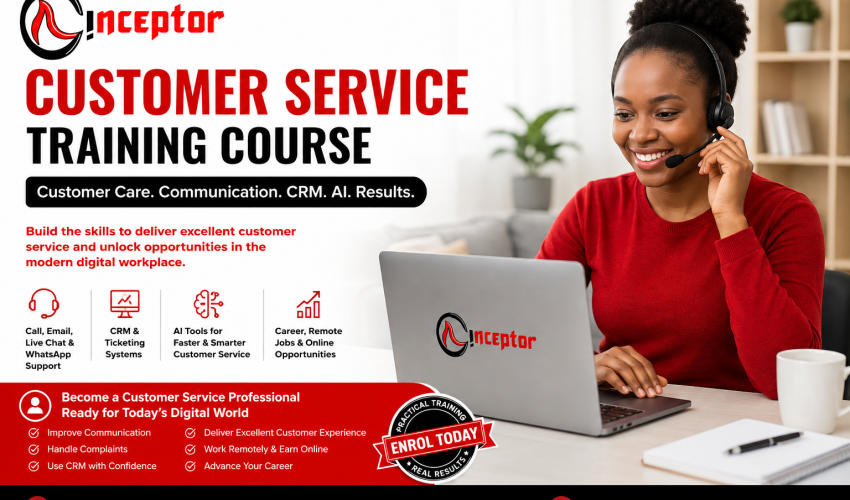
 Customer Service Training with AI

Learn the Customer Service Skills Employers Need Today
Customer service is changing rapidly because of Artificial Intelligence and automation.
AI can now answer frequently asked questions, summarise conversations, draft email responses, organise customer information and help businesses operate chatbots.
However, businesses still require people who can understand customers, communicate clearly, exercise judgement, resolve unusual problems and manage difficult situations.
At Inceptor, we therefore train learners to combine human customer service skills with digital and AI tools.
Instead of competing against AI, you learn how to use AI to become a more productive customer service professional.
What You Will Learn
Module 1: Introduction to Customer Service
Learn the foundations of excellent customer service.
Topics include:
- What customer service means
- Understanding customer expectations
- Internal vs external customers
- Customer needs and behaviour
- Customer-first thinking
- Professional customer service standards
- Creating positive first impressions
- Building customer trust
- Customer satisfaction and loyalty
Module 2: Professional Communication Skills
Communication is at the centre of customer service.
You will learn:
- Verbal communication
- Professional written communication
- Active listening
- Asking the right questions
- Tone of voice
- Body language
- Empathy
- Emotional intelligence
- Cross-cultural communication
- Professionalism
- Communicating with different personality types
- Communicating clearly under pressure
Learners participate in practical customer-service conversations and role plays.
Module 3: Telephone & Call Centre Customer Service
Learn how professional customer support is delivered through telephone and call-centre environments.
Topics include:
- Professional telephone etiquette
- Receiving customer calls
- Making outbound calls
- Call opening and closing
- Understanding customer needs
- Call scripts
- Call documentation
- Call escalation
- Managing call queues
- First-contact resolution
- Handling angry callers
- Follow-up procedures
Module 4: Email Customer Service
Businesses increasingly communicate with customers through email.
Learn how to:
- Write professional customer service emails
- Respond to enquiries
- Write complaint responses
- Create clear email subject lines
- Personalise customer communication
- Follow up with customers
- Maintain professional tone
- Use email templates
- Improve response time
- Use AI responsibly to draft and improve customer emails
Module 5: WhatsApp, Live Chat & Social Media Customer Service
Customers increasingly expect businesses to respond through digital channels.
You will learn how to provide professional support through:
- WhatsApp Business
- Website live chat
- Messenger
- Other messaging platforms
Topics include:
- Chat etiquette
- Managing several customer conversations
- Response templates
- Social media complaints
- Moving conversations from public to private channels
- Customer privacy
- Escalating complex enquiries
- Managing online reviews
Module 6: CRM & Customer Support Systems
Modern customer service teams use technology to manage customer relationships.
You will be introduced to Customer Relationship Management (CRM) and customer support systems.
Learn concepts involving platforms such as:
- HubSpot
- Zoho CRM
- Zendesk
- Freshdesk
- Salesforce
- Help desk and ticketing systems
You will learn how to:
- Create customer records
- Record interactions
- Manage support tickets
- Categorise enquiries
- Track unresolved problems
- Assign and escalate cases
- Follow up with customers
- Maintain customer histories
- Use customer information to improve service
Module 7: Handling Difficult Customers & Complaints
One of the most valuable customer-service abilities is knowing what to do when things go wrong.
You will learn:
- Why customers become angry
- Staying professional under pressure
- Active listening during complaints
- De-escalation techniques
- Complaint investigation
- Conflict resolution
- Managing unreasonable demands
- Service recovery
- Escalating serious cases
- Following up after complaints
- Turning dissatisfied customers into loyal customers
Practical Exercise
Imagine a customer ordered a product online but received the wrong item.
Instead of simply saying:
“Sorry for the inconvenience.”
You will learn a structured approach:
Listen → Acknowledge → Investigate → Provide Options → Resolve → Document → Follow Up.
These practical exercises prepare learners for real workplace situations.
Module 8: AI for Customer Service
This module introduces learners to the growing role of Artificial Intelligence in customer support.
You will learn how AI can assist with:
- Drafting customer responses
- Creating email templates
- Generating FAQs
- Summarising customer conversations
- Analysing customer complaints
- Creating chatbot knowledge bases
- Categorising enquiries
- Developing response scripts
- Translating customer messages
- Personalising responses
- Improving response speed
Learners will also understand when human intervention is necessary and why sensitive customer situations should not simply be delegated to AI.
Module 9: Chatbots & Customer Service Automation
Understand how businesses use automated customer support.
Topics include:
- What customer service chatbots are
- How chatbots work
- FAQ automation
- Designing chatbot conversations
- Creating chatbot knowledge
- Human-to-chatbot handover
- When automation should be avoided
- Improving chatbot responses
- Using AI alongside human customer service teams
No programming experience is required for the introductory concepts.
Module 10: Customer Experience (CX)
Customer service solves customer problems.
Customer Experience (CX) examines the customer’s entire relationship with a business.
Learn:
- Customer journey mapping
- Customer touchpoints
- Customer expectations
- Customer satisfaction
- Customer retention
- Customer loyalty
- Personalisation
- Service recovery
- Customer feedback
- Customer experience improvement
Module 11: Customer Service Performance Metrics
Learn how organisations measure customer service performance.
You will be introduced to concepts such as:
- Customer Satisfaction Score (CSAT)
- Net Promoter Score (NPS)
- First Contact Resolution (FCR)
- Response time
- Resolution time
- Customer retention
- Complaint volumes
- Customer feedback analysis
- Service quality monitoring
Understanding these measurements can help learners progress toward supervisory and customer-experience roles.
Module 12: Sales Through Customer Service
Good customer service can also contribute directly to business revenue.
Learn:
- Understanding customer needs
- Product recommendations
- Upselling
- Cross-selling
- Relationship selling
- Customer retention
- Customer follow-up
- Converting enquiries into customers
- Ethical sales communication
Module 13: Remote Customer Service & Virtual Assistant Skills
Customer support is increasingly delivered remotely.
Learners will understand how remote customer service teams operate and how to prepare for opportunities such as:
- Remote customer support representative
- Email support assistant
- Live chat agent
- Virtual customer service assistant
- Customer support virtual assistant
- E-commerce support assistant
- Social media customer care assistant
Training covers:
- Remote work professionalism
- Written communication
- Time management
- Online collaboration
- Customer documentation
- Virtual meetings
- Working independently
- Managing remote customer enquiries
Module 14: Getting Customer Service Jobs & Online Opportunities
Learning the skill is only the first step.
Inceptor helps learners understand how to package and present their customer-service abilities professionally.
You will learn:
- How to prepare a customer service CV
- How to demonstrate customer service skills
- Creating a professional LinkedIn profile
- Preparing for customer service interviews
- Customer service interview questions
- Building a simple customer support portfolio
- Searching for remote customer service opportunities
- Presenting yourself as a virtual customer support professional
- Approaching businesses that need customer support
Customer Service Career Opportunities
After developing the required skills and gaining appropriate experience, learners can pursue roles such as:
Customer Service Representative
Assist customers with questions, complaints, orders and general support.
Customer Care Agent
Provide customer support through telephone, email or digital channels.
Call Centre Agent
Manage inbound or outbound customer calls.
Live Chat Support Agent
Provide real-time customer assistance through websites and apps.
Email Support Specialist
Handle enquiries, complaints and follow-ups through email.
Customer Experience Assistant
Help organisations improve customer satisfaction and customer journeys.
Front Office / Reception Officer
Handle customers and visitors in offices, hotels, hospitals and other organisations.
Social Media Customer Care Agent
Respond to customer enquiries and complaints through social media.
CRM Assistant
Maintain customer records, follow-ups and interactions through CRM systems.
Virtual Customer Support Assistant
Provide customer support remotely for businesses and entrepreneurs.
E-commerce Customer Support Assistant
Help online stores manage enquiries, orders, deliveries, returns and customer complaints.
With experience, learners may progress toward positions such as:
Customer Service Supervisor → Customer Service Manager → Customer Experience Manager → Head of Customer Experience.
Can You Make Money Online with Customer Service Skills?
Yes. Customer service is particularly suitable for remote work because many customer interactions happen through email, live chat, telephone, social media, WhatsApp and CRM systems.
Here are several practical models.
Example 1: Become a Virtual Customer Support Assistant
Suppose an online business receives dozens of WhatsApp messages, emails and social-media enquiries every day.
The owner may not have enough time to respond.
You could offer to:
- Respond to customer enquiries
- Follow up on orders
- Answer FAQs
- Manage WhatsApp messages
- Respond to email
- Update customer records
- Escalate difficult issues
Instead of only applying for permanent employment, you are effectively selling Customer Support as a Service.
For example, if you eventually acquire three small clients paying an illustrative KSh 15,000 per month each:
3 clients × KSh 15,000 = KSh 45,000/month.
This is an illustration rather than a guaranteed income; actual rates depend on workload, experience, client location and service level.
Example 2: Remote Live Chat Support
An international e-commerce company may require someone to respond to website visitors.
A customer asks:
“My order hasn’t arrived. Can you check what happened?”
Your role could involve checking the order record, communicating with the customer, updating the ticket and escalating the issue when necessary.
Because the entire interaction happens online, the work can potentially be performed remotely.
Example 3: Manage Customer Support for an Online Store
Consider a Kenyan Instagram or online shop selling clothes.
The business receives questions such as:
“Do you have size 38?”
“How much is delivery to Nakuru?”
“Has my order been dispatched?”
“Can I exchange this item?”
You can approach such businesses and offer a monthly customer-support package covering WhatsApp, Instagram, order follow-up and complaint management.
This turns customer-service knowledge into a freelance service business.
Example 4: Become an E-commerce Virtual Assistant
You can combine customer service with basic e-commerce skills and offer services such as:
Customer enquiries + order tracking + email support + returns management + CRM updates + product enquiries.
This combination can make you more useful to online businesses than offering general virtual-assistant services alone.
Example 5: Create Customer Service Digital Products
Experienced learners and professionals can eventually package their knowledge into digital resources and sell them online.
Examples include:
- Customer service email templates
- WhatsApp response templates
- Customer complaint scripts
- Call centre scripts
- Customer service checklists
- Customer onboarding templates
- FAQ templates
- Customer service SOP templates
- Customer support prompt packs
- Customer service mini-courses
- Customer service ebooks
These resources can potentially be sold online as digital products, provided they are original or appropriately licensed.
Who Should Take This Customer Service Course?
This training is suitable for:
- KCSE graduates
- College and university students
- Job seekers
- Receptionists
- Front office staff
- Call centre agents
- Sales representatives
- Administrative assistants
- Virtual assistants
- Social media managers
- Entrepreneurs
- Online sellers
- Hospitality professionals
- Customer service employees
- Business owners
- Anyone interested in remote customer support work
No advanced technical background is required.
Why Study Customer Service at Inceptor Institute?
The program focuses on practical, employable and digitally relevant skills rather than customer-service theory alone.
Learners are exposed to realistic situations involving:
Phone + Email + WhatsApp + Live Chat + Social Media + CRM + AI + Customer Experience.
Practical Learning
Learners participate in customer-service simulations and real-world scenarios.
AI-Enhanced Training
Learn how modern customer service professionals can use AI responsibly to improve productivity.
Digital Customer Support
Develop skills applicable to modern online businesses and e-commerce operations.
Career & Freelancing Focus
Learn how customer-service skills can be applied to employment, remote work and freelance service delivery.
Flexible Learning
Physical and online learning options allow working professionals, students and job seekers to participate.
Customer Service Course Details
Course: Customer Service & Customer Experience Training with AI
Training Institution: Inceptor Institute of Technology
Location: Nairobi, Kenya
Learning Options: Physical & Online Training
Training Approach: Practical, instructor-led training
Level: Beginner to Intermediate
Language: English
Assessment: Practical exercises and assessments
Certificate: Certificate upon successful completion
For current duration, fees, intake dates and class schedules, contact Inceptor Institute of Technology.
Frequently Asked Questions
Which is the best customer service course in Kenya?
A useful modern customer service course should cover more than telephone etiquette. Look for training in communication, complaint handling, digital customer support, email, live chat, CRM systems, AI tools and customer experience. Inceptor’s program is designed around this broader practical approach.
Can I study customer service without experience?
Yes. The course can start with customer-service fundamentals before progressing to digital tools, CRM, customer experience and AI-assisted support.
Is customer service a marketable skill in Kenya?
Customer service skills apply across many industries because businesses need people who can communicate with customers, resolve problems and maintain customer relationships. Combining customer-service skills with CRM, digital communication and AI literacy can broaden the types of roles you can pursue.
Can customer service be done remotely?
Yes. Some customer support functions can be performed remotely through email, telephone, live chat, social media, CRM systems and help-desk software.
Can I become a virtual assistant after learning customer service?
Customer service can provide a strong foundation for customer-support virtual assistant work. Adding administrative, e-commerce and digital communication skills can further expand your opportunities.
Do I need programming skills to use AI in customer service?
No. Many AI-assisted customer-service tools are designed for non-programmers. The focus is learning how to use them appropriately while retaining human judgement, empathy and professionalism.
What jobs can I get after customer service training?
Potential roles include customer service representative, customer care agent, call centre agent, front office assistant, live chat support agent, email support specialist, e-commerce customer support assistant, CRM assistant and virtual customer support assistant. Individual job eligibility depends on the employer’s requirements and your overall qualifications.
How can I make money online using customer service skills?
Possible routes include remote customer support employment, freelance customer support, virtual assistance, live-chat support, e-commerce customer support and providing outsourced customer-care services to small businesses.
Start Your Customer Service Career with Inceptor
Customer service is no longer simply about answering telephone calls.
Today’s customer service professional needs to understand people, communication, digital channels, CRM systems, customer experience and Artificial Intelligence.
The Inceptor Customer Service & Customer Experience Training program is designed to help you develop these practical skills and understand how to apply them in the modern workplace.
Whether your goal is to get a customer service job, improve your current career, support an online business, work remotely or build your own customer-support service, the first step is developing practical, market-relevant skills.
Enrol for Customer Service Training at Inceptor Institute of Technology and build skills for the modern customer experience economy.
