
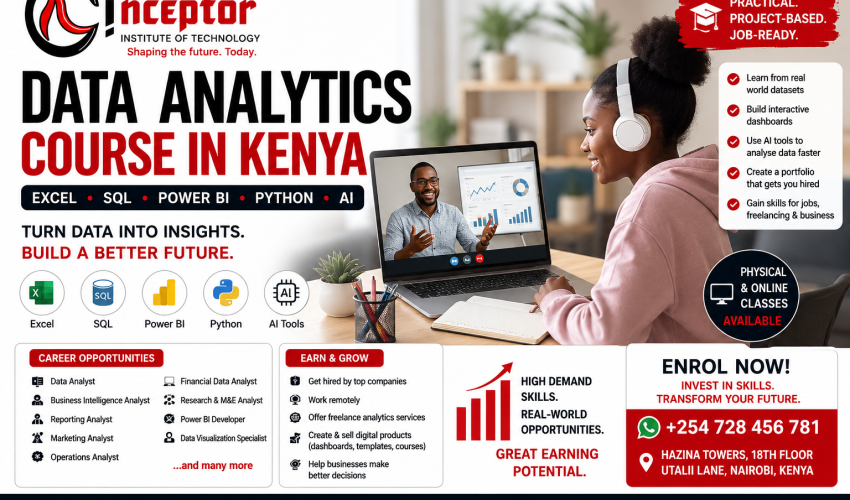
Data Analytics Course in Kenya – Excel, SQL, Power BI, Python & AI Training
Become a Job-Ready Data Analyst with Practical, Real-World Skills
Turn raw data into valuable business insights with practical Data Analytics training at Inceptor Institute of Technology.
Our Data Analytics Course in Kenya is designed for beginners, students, graduates, working professionals, entrepreneurs and career changers who want to learn how to analyse data, create professional dashboards, identify trends and help organisations make better decisions.
The training focuses on practical skills using tools such as:
Microsoft Excel • SQL • Power BI • Python • Tableau • AI Tools • Data Visualization • Business Intelligence
You don’t just learn how data analytics works. You learn how to solve real business problems with data and build projects you can demonstrate to employers or clients.
Course Duration: 6 Months
Mode of Study: Physical & Online Training
Location: Nairobi, Kenya
Level: Beginner to Job-Ready
Training Approach: Practical, Project-Based Learning
What Is Data Analytics?
Data analytics is the process of collecting, cleaning, analysing and interpreting data to discover useful patterns and insights that can support better decisions.
Consider a supermarket with thousands of transactions.
Management may want to know:
- Which products generate the most revenue?
- Which branches are performing poorly?
- What days generate the highest sales?
- Which products are frequently purchased together?
- Which customers buy most frequently?
- Are sales increasing or declining?
A trained data analyst can take the company’s raw sales data, clean it using Excel, Python or SQL, analyse the information and build an interactive Power BI dashboard showing management exactly what is happening.
That ability to transform numbers into decisions is what makes data analytics valuable across modern organisations.

Why Learn Data Analytics in Kenya?
Almost every modern organisation generates data.
Banks analyse transactions. Hospitals analyse patient and operational data. E-commerce companies analyse customer behaviour. NGOs analyse project performance. Schools analyse student performance. Telecommunications companies analyse customer usage, while retailers analyse sales, inventory and purchasing patterns.
But collecting data is not enough.
Organisations need people who can answer:
What is the data telling us, why is it happening, and what should we do next?
This creates opportunities for people who can combine analytical thinking with Excel, SQL, Power BI, Python, visualization and increasingly Artificial Intelligence (AI).
Data Analytics + AI: Skills for the Modern Analyst
Artificial Intelligence is changing how analysts work.
Instead of replacing the need for data skills, AI is giving analysts powerful new ways to work faster.
During the course, learners will explore how AI can assist with activities such as:
- generating and explaining SQL queries;
- analysing spreadsheet data;
- identifying possible trends and anomalies;
- assisting with Python code;
- suggesting appropriate visualizations;
- summarising analytical findings;
- creating executive reports;
- explaining complex datasets in simple language; and
- automating repetitive analytical tasks.
The objective is to develop an analyst who understands both the fundamentals of data analysis and how to use AI responsibly to improve productivity.
What You Will Learn
Module 1: Data Analytics Fundamentals
Start by understanding the complete data analytics process.
Learn:
- What is data analytics?
- Data analytics vs data analysis vs data science
- Types of data
- Structured and unstructured data
- Data collection
- Data quality
- Data cleaning
- Exploratory data analysis
- Descriptive, diagnostic, predictive and prescriptive analytics
- Asking the right business questions
- Data ethics and privacy
- Turning business problems into analytical questions
Module 2: Excel for Data Analysis
Microsoft Excel remains an important tool for analysts and business professionals.
You will learn how to work with real datasets using:
- Excel formulas and functions
- IF statements
- XLOOKUP/VLOOKUP
- SUMIFS and COUNTIFS
- Sorting and filtering
- Data validation
- Data cleaning
- PivotTables
- PivotCharts
- Conditional formatting
- Power Query fundamentals
- Charts and visualizations
- KPI reporting
- Interactive Excel dashboards
Practical Project
Take a raw sales spreadsheet containing hundreds or thousands of transactions and transform it into an executive sales dashboard.
Module 3: SQL for Data Analytics
Businesses store enormous amounts of information in databases.
SQL enables analysts to retrieve and analyse that information.
Learn:
- Database fundamentals
- Tables, rows and columns
- SELECT
- WHERE
- ORDER BY
- GROUP BY
- Aggregate functions
- JOINs
- Subqueries
- CASE statements
- Common Table Expressions
- Cleaning data with SQL
- Business reporting queries
- Querying multiple tables
Practical Project
Analyse an e-commerce database to identify:
best customers → top products → sales trends → revenue → repeat purchases → underperforming categories.
Module 4: Power BI & Business Intelligence
Learn how organisations turn data into interactive management dashboards.
Topics include:
- Introduction to Power BI
- Importing datasets
- Power Query
- Data transformation
- Data modelling
- Relationships
- DAX fundamentals
- Measures and calculated columns
- KPI development
- Interactive visualizations
- Filters and slicers
- Dashboard design
- Business Intelligence reporting
- Data storytelling
Practical Project
Build an interactive company performance dashboard that a manager can use to track revenue, customers, products and regional performance.
Module 5: Python for Data Analysis
Move beyond spreadsheets and learn how Python can be used to analyse larger and more complex datasets.
Topics include:
- Python fundamentals for analysts
- Jupyter Notebook
- NumPy
- Pandas
- Importing CSV and Excel data
- DataFrames
- Missing data
- Cleaning datasets
- Filtering and grouping
- Data transformation
- Statistical analysis
- Matplotlib
- Exploratory Data Analysis
- Automating repetitive analysis
Practical Project
Use Python to clean and analyse a large dataset and produce actionable insights.
Module 6: Data Visualization & Tableau
Learn how to communicate findings visually.
Topics include:
- Principles of effective visualization
- Choosing the correct chart
- Tableau fundamentals
- Building dashboards
- Interactive reports
- KPI visualization
- Data storytelling
- Presenting findings to non-technical audiences
Module 7: Statistics for Data Analysts
You don’t need to become a mathematician to become a data analyst, but you need to understand what the numbers mean.
Learn practical concepts including:
- Mean, median and mode
- Percentages
- Variance
- Standard deviation
- Distribution
- Correlation
- Probability fundamentals
- Sampling
- Outliers
- Trend analysis
- Basic forecasting
- Interpreting statistical results
Module 8: AI for Data Analytics
Learn how modern analysts can combine traditional analytical tools with generative AI.
Practical exercises can include:
Dataset → AI-assisted exploration → Excel/SQL/Python analysis → visualization → interpretation → business recommendation
Learners will explore AI-assisted:
- Excel formulas
- SQL development
- Python troubleshooting
- data exploration;
- report generation;
- visualization planning;
- business insight generation; and
- analytical workflow automation.
You will also learn why analysts must verify AI-generated results rather than blindly trusting them.
Module 9: Business Intelligence & Real-World Analytics
Technical skills alone do not make a successful analyst.
You must understand the business problem behind the numbers.
Learners therefore work on scenarios from:
- Sales
- Finance
- Marketing
- E-commerce
- Human Resources
- Healthcare
- Education
- NGOs
- Agriculture
- Logistics
- Customer service
The emphasis is on answering practical questions and recommending action.
Module 10: Portfolio, Freelancing & Career Preparation
Complete the program with projects that demonstrate what you can actually do.
Learn how to:
- Build a data analytics portfolio
- Document projects
- Present dashboards
- Write analytical case studies
- Prepare a data analyst CV
- Optimise your LinkedIn profile
- Prepare for technical interviews
- Find internships
- Search for entry-level analyst positions
- Identify remote opportunities
- Offer freelance data-analysis services
- Present analytical solutions to businesses
Projects You Can Add to Your Portfolio
Instead of completing the course with only a certificate, learners should aim to graduate with demonstrable projects such as:
- Sales Analytics Dashboard
Analyse sales, products, customers and regions using Excel or Power BI. - E-commerce Customer Analysis
Use SQL to analyse customer behaviour, orders and revenue. - HR Analytics Dashboard
Analyse employee demographics, turnover, absenteeism and workforce trends. - Marketing Campaign Analysis
Determine which marketing channels and campaigns generate the best results. - Financial Performance Dashboard
Visualise revenue, expenses, profitability and performance trends. - Python Data Analysis Project
Clean, analyse and visualize a real-world dataset using Python.
These projects can become evidence of your abilities when approaching employers and clients.
What Jobs Can You Get After Learning Data Analytics?
Data analytics skills can support career paths such as:
- Data Analyst
- Junior Data Analyst
- Business Intelligence Analyst
- Reporting Analyst
- Business Analyst
- Marketing Analyst
- Sales Analyst
- Operations Analyst
- Financial Data Analyst
- Research Analyst
- Monitoring & Evaluation Data Analyst
- Power BI Developer
- Data Visualization Specialist
- Analytics Consultant
Your suitability for a particular position will depend on your portfolio, experience, education and the employer’s requirements.
Industries That Need Data Analysts
Data analytics isn’t restricted to technology companies.
The same skills can be applied in:
- Banking & Finance: transaction, customer and risk analysis.
- Healthcare: operational and patient-data analysis.
- Retail: sales, inventory and customer analysis.
- E-commerce: conversion, customer behaviour and product performance.
- Telecommunications: customer behaviour and service performance.
- Marketing: campaigns, advertising and customer acquisition.
- NGOs: monitoring, evaluation, research and program reporting.
- Education: enrolment, performance and institutional reporting.
- Agriculture: production, market and supply-chain analysis.
- Government: planning, service delivery and statistical reporting.
- This means learning analytics does not necessarily require abandoning your existing profession.
- A finance professional can become a financial analyst.
- A marketer can become a marketing analyst.
- An HR professional can specialise in people analytics.
- A salesperson can use analytics for sales forecasting.
- An entrepreneur can analyse their own business.
Data analytics can therefore become either a new career or a valuable additional skill within an existing career.
Can You Make Money with Data Analytics Skills?
Yes. Employment is only one potential pathway.
People with strong analytical skills can also provide services to businesses, organisations and entrepreneurs.
For example, imagine a small business has accumulated 12 months of sales records in Excel but the owner cannot easily determine:
- monthly revenue trends;
- best-selling products;
- weak-performing products;
- best customers; or
- seasonal purchasing patterns.
A skilled analyst could clean that data and develop a Power BI sales dashboard showing the owner exactly how the business is performing.
That becomes a service you can sell.
Another client might be an NGO that needs survey data cleaned and summarized.
Another may require an Excel dashboard.
Another business might require monthly reporting.
Another could need SQL queries or database reports.
The same underlying analytical skills can therefore generate multiple income opportunities.
Freelancing Opportunities for Data Analysts
Once you have developed sufficient competence and a strong portfolio, you can potentially offer services such as:
- Excel data cleaning
- Spreadsheet analysis
- Power BI dashboard development
- Tableau dashboards
- SQL reporting
- Data visualization
- Survey data analysis
- Business reporting
- KPI dashboards
- Market research analysis
- Python data analysis
- Automated reporting
- Data presentation and storytelling
Rather than advertising yourself simply as a “data analyst,” package the outcome.
For example:
“I will build an interactive Power BI sales dashboard for your business.”
or:
“I will clean and analyse your Excel sales data and create a management report.”
A specific business solution is easier for potential customers to understand than a vague technical skill.
Turn Your Data Analytics Knowledge into Digital Products
Data analytics skills can also be packaged into reusable digital products.
After becoming competent in a specific area, you could create and sell digital products such as:
- Excel financial templates
- Business KPI dashboards
- Sales tracking spreadsheets
- Inventory dashboards
- Power BI dashboard templates
- Data-cleaning checklists
- Excel tutorials
- SQL practice exercises
- Data analytics micro-courses
- Industry-specific reporting templates
Realistic Example
Suppose you become particularly good at creating Excel dashboards for small businesses.
Instead of only creating dashboards individually for clients, you could develop a reusable:
“Small Business Sales & Profit Dashboard – Excel Template”
A business owner enters their sales and expense information, and the template automatically generates useful performance indicators and charts.
You could sell the template as a digital product on platforms such as Vezill while continuing to offer customized analytics services to clients who need more advanced solutions.
This creates three possible career paths from the same skill:
Learn Data Analytics → Get Employed
Learn Data Analytics → Offer Freelance Services
Learn Data Analytics → Create Digital Products
And these options can be combined.
Who Should Take This Data Analytics Course?
This course is suitable for:
- University and college students
- Recent graduates
- Professionals seeking additional digital skills
- Accountants and finance professionals
- Sales and marketing professionals
- Entrepreneurs
- Researchers
- NGO professionals
- Monitoring & Evaluation professionals
- HR professionals
- Managers
- Career changers
- Anyone interested in working with data
Do I Need Programming Experience?
No.
The course can begin with foundational analytical concepts and Excel before progressing into SQL, Power BI, Python and more advanced analysis.
This makes it possible for beginners to develop their abilities progressively.
Why Study Data Analytics at Inceptor?
At Inceptor Institute of Technology, our emphasis is on learning by doing.
The objective is not simply to teach definitions and software menus.
You should learn how to take a real business problem and move through the complete analytical process:
Business Question → Collect Data → Clean Data → Analyse → Visualize → Interpret → Recommend Action
The program combines:
- Instructor-led training
- Practical exercises
- Real-world datasets
- Portfolio projects
- Business case studies
- AI-assisted analytics
- Career preparation
- Freelancing skills
- Digital entrepreneurship
By completion, learners should be able to demonstrate what they can do—not merely say they studied data analytics.
Frequently Asked Questions
Which data analytics course is best for beginners in Kenya?
A beginner-friendly course should teach the complete analytical workflow and practical tools such as Excel, SQL, Power BI and data visualization before progressing into Python and more advanced analytics. Practical projects are particularly important because they allow learners to demonstrate their skills.
Is data analytics marketable in Kenya?
Data analytics skills are applicable across banking, telecommunications, retail, NGOs, healthcare, education, e-commerce, logistics, government and many other sectors. Employers increasingly need professionals capable of transforming organisational data into useful business insights.
Can I learn data analytics without a degree?
You can learn data analytics skills without having a degree in computer science. However, individual employers may specify their own educational requirements. Building practical skills and a strong project portfolio can help demonstrate your abilities.
Which tools should a data analyst learn?
Important tools include Excel, SQL, Power BI, Python and data visualization platforms such as Tableau. Modern analysts should also understand how AI can assist with analysis while maintaining human verification and sound analytical judgement.
Can I become a data analyst without coding?
You can begin data analytics without programming. Excel and Power BI provide powerful analytical capabilities without extensive coding. Learning SQL and eventually Python, however, can substantially expand the types and scale of analysis you can perform.
Can data analytics help me make money online?
Potentially. Skilled analysts can offer services including Excel analysis, dashboard development, data cleaning, SQL reporting and visualization. Experienced learners can also package selected skills into templates, tutorials and other digital products.
What should I have after completing a data analytics course?
Ideally, you should leave with more than a certificate. You should have practical competence and a portfolio containing dashboards, SQL analysis, Excel projects, Python analysis and real-world case studies that demonstrate your abilities.
Start Your Data Analytics Career Today
Every day, businesses collect more information.
The opportunity belongs to people who know how to turn that information into answers, insights and better decisions.
Whether your goal is to:
get a data analyst job, upgrade your current career, work remotely, provide freelance analytics services, help businesses make better decisions, or build digital products from your knowledge,
Inceptor’s practical Data Analytics training can help you develop the foundation you need.
Don’t Just Learn Data Analytics. Learn How to Use It.
Enrol for Data Analytics Training at Inceptor Institute of Technology.
📍 Nairobi – Hazina Towers, 18th Floor, Utalii Lane
💻 Online & Physical Classes Available
📞 Call/WhatsApp: +254 728 456 781
Start building practical, job-ready data skills today.
