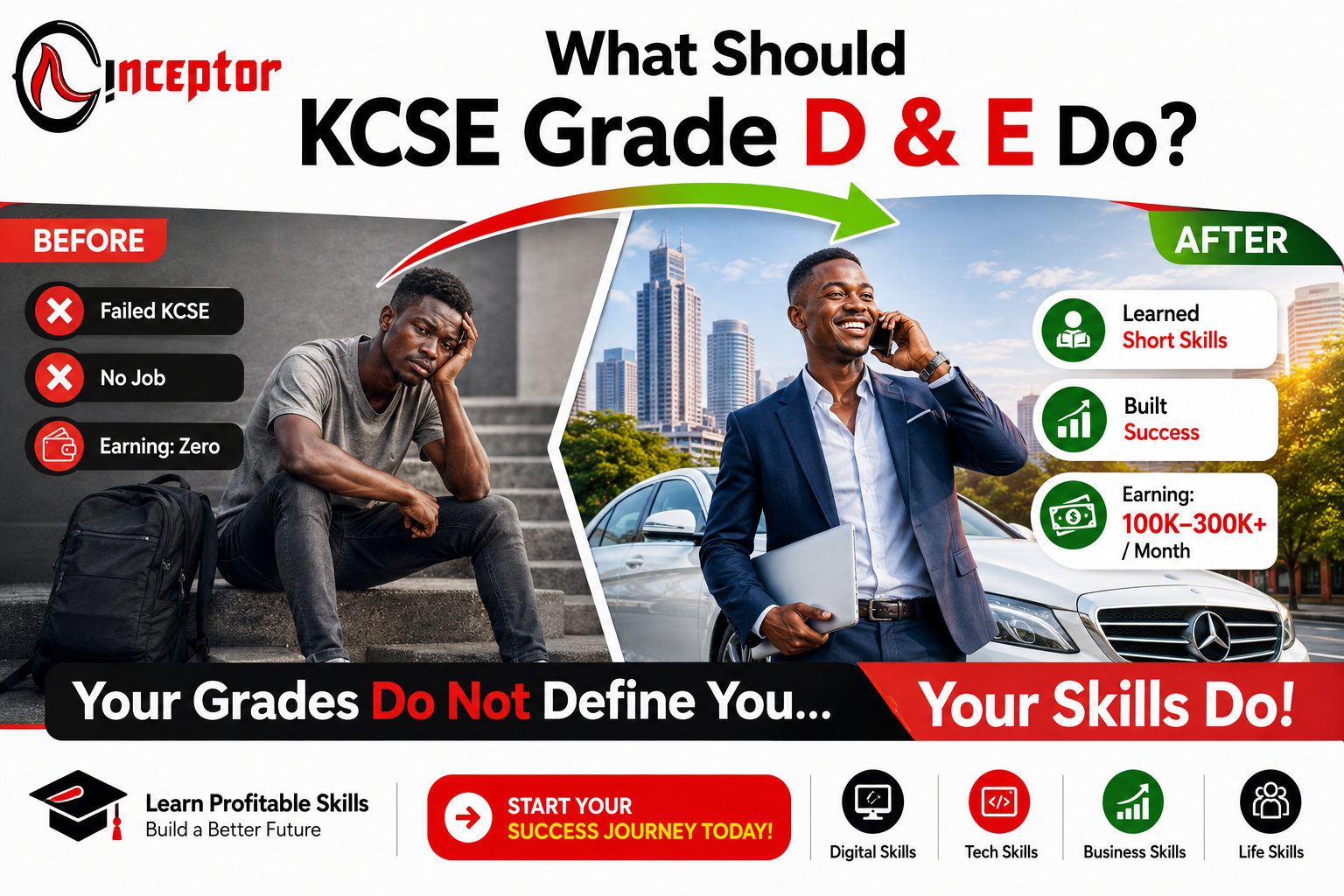
What to Do With a KCSE Grade D or E in Kenya: Best Courses, Skills & Opportunities
Scored a D+, D, D- or E in KCSE and wondering what to do next?
The short answer is: you still have several education, skills, employment and entrepreneurship pathways available in Kenya.
A KCSE grade can determine which course level you enter immediately, but it does not determine how far you can progress in your career.
A student with a D or E can choose a practical TVET course, learn a marketable digital skill, enter an apprenticeship, start a service business or learn how to create and sell digital products online.
The most important question after KCSE therefore becomes:
What useful skill can I learn that somebody will be willing to pay me for?
This guide explains practical options for students who scored D+, D, D- or E in KCSE, including courses to consider, digital skills, technical careers, self-employment opportunities and how beginners can start a digital products business.
Quick Answer: What Can I Do With a D or E in KCSE?
If you scored a D or E in KCSE, consider these pathways:
- Join a TVET institution.
- Take an artisan or craft/certificate course appropriate for your grade.
- Learn a short marketable skill.
- Learn computer and AI skills.
- Learn a practical trade such as electrical installation, plumbing, welding or beauty.
- Learn graphic design or video editing.
- Learn digital marketing and social media management.
- Start freelancing or offering services to local businesses.
- Learn how to create and sell digital products.
- Combine a practical skill with digital entrepreneurship.
You do not necessarily have to choose between college and making money.
A strong strategy for many young people is:
Formal qualification + practical skill + digital skill + entrepreneurship
That combination can give you more options than relying on a certificate alone.
Did You Fail KCSE If You Got a D or E?
A D or E means you did not attain the grade required for direct university degree placement, but it does not mean that education ends there.
Kenya’s TVET system provides different entry levels.
Current KUCCPS guidance generally places the minimum requirements at:
| KCSE Grade | Typical Entry Path |
| C+ and above | Degree eligibility |
| C / C- | Diploma / Level 6 |
| D+ / D | Certificate / Level 5 |
| D- / E | Artisan / Level 4 |
Individual programmes can have additional requirements, so always check the current admission requirements before applying.
This creates a progression route.
For example:
KCSE → Artisan/Level 4 → Level 5 → Level 6 → Higher Qualification
Your KCSE grade therefore determines your starting point, not necessarily your final destination.
Best Courses for KCSE Grade D Students in Kenya
Students with D+, D or related grades should prioritise courses that teach demonstrable skills rather than selecting a programme simply because it is available.
Depending on the specific grade, institution and programme requirements, areas worth investigating include:
1. Information and Communication Technology
ICT can introduce you to:
- Computer applications
- Office productivity software
- Internet applications
- Computer maintenance
- Networking fundamentals
- Digital communication
- Online business
- Basic technical support
You can then add specialised short courses such as graphic design, digital marketing, web design or AI tools.
2. Electrical Installation
Electrical skills can create opportunities in:
- Domestic wiring
- Electrical maintenance
- Installation
- Fault diagnosis
- Solar-related services
- Construction projects
An electrician can eventually progress from working for another technician to handling independent jobs and potentially running an electrical services business.
3. Plumbing
Plumbing is another practical skill that can lead to both employment and self-employment.
A trained plumber can provide services such as:
- Pipe installation
- Leak repair
- Bathroom installations
- Water tank connections
- Drainage work
- Property maintenance
Instead of thinking only about “Which company will employ me?”, learn to ask:
“Which problems can I solve for customers?”
4. Welding and Fabrication
Possible opportunities include fabrication of:
- Gates
- Doors
- Windows
- Frames
- Shelves
- Furniture
- Metal structures
A learner can start as an apprentice or employee, build experience and later take independent jobs.
5. Automotive and Motorcycle Repair
Kenya has a large vehicle and motorcycle economy.
Practical training can create opportunities in:
- Vehicle servicing
- Motorcycle repair
- Diagnostics
- Electrical systems
- Spare-parts related businesses
- Mobile repair services
The long-term opportunity is not limited to employment in a garage. An experienced technician may eventually operate their own workshop.
6. Hairdressing, Barbering and Beauty
Beauty and grooming are particularly suitable for students interested in service-based entrepreneurship.
Possible skills include:
- Barbering
- Hairdressing
- Braiding
- Nail technology
- Makeup
- Beauty therapy
The advantage is that you can begin with a relatively small customer base and grow through referrals, TikTok, Instagram, Facebook and WhatsApp.
7. Food Production, Baking and Catering
Food skills can lead to employment or small businesses involving:
- Cakes
- Pastries
- Snacks
- Outside catering
- Meal preparation
- Event catering
- Food delivery
A learner can combine culinary training with social-media marketing to build a local customer base.
8. Agriculture and Agribusiness
Agriculture should not automatically be viewed as traditional subsistence farming.
Young people can explore areas such as:
- Poultry
- Horticulture
- Dairy
- Beekeeping
- Aquaculture
- Seedling production
- Value addition
- Agricultural marketing
Technology can also be incorporated into these businesses through online marketing, digital record keeping and educational content.
Best Courses for KCSE Grade E Students in Kenya
A KCSE Grade E student also has recognised training pathways.
Depending on current programme requirements, Level 4/artisan training can include areas such as:
- Electrical installation
- Computer-related training
- Automotive mechanics
- Motorcycle mechanics
- Welding
- Masonry
- Carpentry and joinery
- Beauty therapy
- Hairdressing
- Culinary arts
- Agriculture
- Food production
- Computer and mobile-device repair
The objective should be to start at the level you qualify for, acquire competence and progress from there.
What About Short Courses That Do Not Depend Heavily on KCSE Grades?
This is where the digital economy creates another opportunity.
Many practical short courses focus more on whether you can learn and demonstrate the skill than on your KCSE mean grade.
At Inceptor Institute of Technology, learners can explore practical digital and technology skills designed to complement formal education.
Some useful areas include:
Computer Packages
Start here if your computer skills are weak.
Learn practical skills such as:
- Microsoft Word
- Excel
- PowerPoint
- Internet research
- File management
- Google productivity tools
These are foundational skills for many modern jobs and businesses.
Learn AI Skills – Even If You Scored D or E
Artificial intelligence is changing the meaning of digital literacy.
You do not need to become an AI engineer before you can use AI productively.
A beginner can learn how to use tools such as ChatGPT and other AI applications for:
- Research
- Writing
- Brainstorming
- Customer service
- Creating presentations
- Marketing
- Content planning
- Data organisation
- Designing digital products
- Business automation
The important skill is not simply knowing how to open ChatGPT.
It is learning how to use AI to solve real problems faster and produce useful work.
Graphic Design
Graphic design can be a practical starting point for a creative learner.
You can learn to create:
- Posters
- Social-media graphics
- Business cards
- Menus
- Flyers
- Product advertisements
- YouTube thumbnails
- eBook covers
Realistic Illustration
Suppose Brian learns Canva and graphic-design fundamentals.
He approaches small businesses near his estate and gets three clients who each need four social-media posters per month.
If he charges an illustrative KSh 500 per design:
3 clients × 4 designs × KSh 500 = KSh 6,000
That is not a guaranteed income. It is simply an example of how a beginner can turn a skill into a small service business.
As Brian’s portfolio and ability improve, he can pursue larger clients and higher-value projects.
Video Editing
Video is central to TikTok, Instagram Reels, YouTube and online advertising.
A learner can start with phone-based editing before progressing to professional software.
Potential customers include:
- Content creators
- Churches
- Restaurants
- Schools
- Property agents
- Small businesses
- Coaches
- Event organisers
A student who becomes good at editing short-form videos can sell a service without needing a traditional office.
Digital Marketing
Every business needs customers.
That makes digital marketing useful across many industries.
Skills can include:
- Social media marketing
- Content creation
- SEO
- Email marketing
- WhatsApp marketing
- Online advertising
- Lead generation
- Analytics
- AI-assisted marketing
Instead of waiting for a digital-marketing vacancy, a learner can approach local businesses and offer to improve their online presence.
Website Design
Businesses increasingly need websites and landing pages.
A beginner can start with tools such as WordPress and learn how to build:
- Small business websites
- Blogs
- Portfolio websites
- Landing pages
- Online shops
Illustration
Suppose a learner becomes competent enough to build a simple business website and charges KSh 15,000.
If they acquire one client in a month, that project could generate KSh 15,000 in gross revenue before expenses.
Two such projects would represent KSh 30,000.
Again, this is an illustration—not an earnings guarantee. Getting clients requires competence, marketing, trust and consistent effort.
Cybersecurity and Coding: Can a D Student Learn Them?
Yes, but it is important to separate learning a skill from meeting admission requirements for a particular formal qualification.
A learner can start developing foundational knowledge in areas such as:
- Networking
- Linux
- Cybersecurity fundamentals
- Python
- Web development
- Technical support
You can start small and progressively build competence.
For technical careers, your portfolio, certifications, practical projects and continued education can become increasingly important as you progress.
One of the Biggest Opportunities: Combine a Skill With Digital Entrepreneurship
This is particularly relevant for the next generation of KCSE leavers.
Do not only learn a skill.
Learn:
Skill → Service → Content → Digital Product → Online Business
Consider a student who learns baking.
The traditional approach is:
Learn baking → look for a bakery job.
A more entrepreneurial approach could be:
Learn baking → sell cakes → build an audience → teach beginners → create a recipe guide or mini-course → sell it online.
The original practical skill becomes the foundation of several possible income streams.
What Is Digital Product Trading?
Digital product trading involves creating, marketing, selling or legitimately reselling products that can be delivered digitally.
Examples include:
- eBooks
- PDF guides
- Video tutorials
- Online courses
- Templates
- Checklists
- Planners
- Study materials
- Design resources
- Business resources
- AI prompt packs
Unlike a physical product, a digital product does not need to be manufactured again every time another customer purchases it.
However, success still requires learning digital product trading skills, creating a useful product, a genuine market, effective promotion and customer trust.
How Can a KCSE D or E Student Start Selling Digital Products?
You don’t have to begin as an expert.
Start with a useful skill or problem.
Step 1: Learn One Marketable Skill
Choose something you can practise.
For example:
Video editing
Do not try to learn ten skills simultaneously.
Become useful at one.
Step 2: Practise the Skill
Create sample projects.
For video editing, you might create:
- Five TikTok videos
- Three promotional reels
- Before-and-after edits
- A one-minute advertisement
These become your portfolio.
Step 3: Start Offering the Skill as a Service
Find small customers.
For example:
“I create short promotional videos for businesses.”
Your first objective is not to become rich.
It is to prove that someone is willing to pay for the value you create.
Step 4: Turn Your Knowledge Into a Digital Product
After gaining experience, you could create:
“How to Edit Professional TikTok Videos Using Your Phone”
The product could be:
- A PDF guide
- Video tutorials
- Templates
- A mini-course
Now the same skill has created both a service and a digital product.
Step 5: Sell the Product Online
Upload the product to a suitable digital-product marketplace or selling platform.
Then market it through:
- TikTok
- YouTube
- SEO
- Your website
What If You Cannot Create Your Own Digital Product Yet?
Another model is reselling digital products where the licence specifically permits resale.
This point is important.
You cannot simply download somebody else’s eBook, course or template and sell it.
You must have the appropriate licence or resale rights.
Platforms such as Vezill can provide a marketplace model where eligible products include defined resale rights.
A beginner could therefore learn:
Find product → understand licence → identify audience → create marketing content → promote → generate sale → reinvest
The key skill is not merely “buying and reselling.”
It is learning digital marketing and customer acquisition.
Example: How a KCSE Grade D Student Could Build a Digital Business
Consider a fictional student named Kevin.
Kevin scores a D in KCSE.
Instead of spending the next year doing nothing while waiting for an opportunity, he chooses to learn:
Computer skills + graphic design + AI + digital marketing
During the first month, he concentrates on computer and design fundamentals.
During the second month, he builds sample posters and learns how to use AI for research, copywriting and content ideas.
During the third month, he approaches small businesses.
A barber needs posters.
A restaurant needs menu graphics.
A small online seller needs product advertisements.
Kevin starts charging modest beginner rates while improving his portfolio.
He then notices other beginners asking him how he creates his designs.
That becomes a digital-product opportunity.
He creates:
“Canva Poster Design for Beginners: A Step-by-Step Guide”
He can sell the guide online while continuing to provide design services.
His business model becomes:
Graphic-design skill → freelance service → portfolio → audience → digital guide → online sales
Later he could create video lessons or a complete beginner course.
That is digital entrepreneurship.
Example: How a Grade E Student Could Combine a Trade With Digital Products
Consider Mary, who scored an E and decides to pursue hairdressing.
She learns:
- Braiding
- Hair treatment
- Customer care
- Basic business management
But she also learns:
- TikTok content creation
- Canva
- WhatsApp Business
- AI-assisted content creation
Mary begins posting short hair tutorials online.
Over time, potential customers discover her work.
She can now earn from physical hairdressing services while building an online audience.
Once she has sufficient practical experience, she could create:
“Beginner’s Home Hair-Care Guide”
or:
“10 Easy Hairstyles for Beginners”
She has transformed one vocational skill into:
Service + content + personal brand + digital product
This is the mindset young people should be developing for the future economy.
What Digital Products Could a KCSE Leaver Create?
Your first digital product does not need to be complicated.
If you genuinely understand a useful subject, possibilities include:
- Beginner Canva guide
- Beginner barbering checklist
- Poultry record template
- Cake pricing spreadsheet
- Hair-care planner
- Job application checklist
- Small-business social-media templates
- Revision planner
- Personal budget template
- Farming record book
- Beginner photography guide
- Video-editing tutorial
- Business quotation template
The principle is simple:
Solve one small problem for one specific group of people.
A Better Career Formula for the Future
The traditional formula was:
KCSE → College → Certificate → Apply for jobs
That pathway still works for many careers.
But a future-ready student should consider building a broader pathway:
KCSE → Skill → Portfolio → Experience → Income → Digital Presence → Entrepreneurship → Further Education
These approaches are not mutually exclusive.
You can attend TVET while learning digital skills.
You can be an electrician and learn digital marketing.
You can be a hairdresser and sell a course.
You can study agriculture and create farming guides.
You can learn automotive repair and create vehicle-maintenance tutorials.
The internet allows practical knowledge to become both a service and an information product.
Parents: What Should You Do If Your Child Scores D or E in KCSE?
Parents have an important role at this stage.
Avoid treating a disappointing KCSE result as the end of your child’s future.
Instead, ask practical questions:
What is this student naturally interested in?
Does the student prefer practical work, technology, business, creative work or working with people?
Which marketable skill could match those strengths?
Which recognised education pathway can the student enter?
What digital skill could complement that career?
For example, a child interested in cars may struggle in an academic classroom but perform exceptionally well in automotive technology.
A creative student may thrive in graphic design, video production or fashion.
Another may excel in electrical work, plumbing, beauty, agriculture or sales.
The objective is not to pretend KCSE grades do not matter.
They matter for admission into particular programmes.
But they are one factor in a much larger career journey.
What Should You Do Immediately After Getting a D or E?
Use the first 90 days productively.
Days 1–7: Research
Identify three possible paths:
- One formal TVET option
- One practical/digital skill
- One possible business opportunity
Days 8–30: Start Learning
Choose your strongest option and begin.
Do not spend six months merely watching motivational videos.
Start practising.
Month 2: Build Something
Depending on your skill, create:
- A website
- Five posters
- Ten edited videos
- A repaired device
- A hairstyle portfolio
- A baked product
- An electrical project
- A farming project
You need evidence that you can perform the skill.
Month 3: Find Your First Customer
Start small.
Your first customer is more important than fantasising about KSh 100,000 per month.
Learn:
How do I get one person to pay me?
Once you understand that process, improve it and repeat it.
Which Skills Are Likely to Remain Valuable in the Future?
Technology will continue changing individual jobs.
For this reason, future students should develop a combination of technical and human capabilities.
Useful areas include:
- AI literacy
- Digital marketing
- Data literacy
- Cybersecurity
- Coding
- Web development
- Video production
- Content creation
- Sales
- Customer service
- Electrical and renewable-energy skills
- Automotive technology
- Repair and maintenance
- Agribusiness
- Entrepreneurship
But there are also four foundational capabilities every learner should develop:
Communication + Problem Solving + Digital Literacy + Ability to Learn
Tools will change.
Those abilities remain valuable.
Should I Repeat KCSE or Learn a Skill?
It depends on your objective.
Repeating KCSE may make sense when the career you specifically want requires academic grades that you currently do not have and you have a realistic plan for improving them.
But repeating KCSE is not the only route.
If your goal can be reached through TVET, vocational progression, entrepreneurship or skills-based training, you may decide to start there instead.
Do not repeat an examination simply because you feel embarrassed about your grade.
Have a career objective first, then choose the pathway that best moves you towards it.
Can Someone With a D or E Become Successful?
Yes – but success is not automatic.
Neither a degree nor a short course guarantees income.
A more useful equation is:
Skill + Practice + Discipline + Portfolio + Sales Ability + Consistency = Opportunity
Someone who learns a practical skill but never practises it may remain unemployed.
Someone who learns a skill, builds a portfolio, finds customers, keeps improving and learns business has considerably more options.
From KCSE Grade D or E to Your First Income: A Practical Roadmap
Here is a simple roadmap:
- Accept your starting point
↓
- Choose a practical career direction
↓
- Join an appropriate TVET or skills programme
↓
- Add computer and AI literacy
↓
- Master one marketable skill
↓
- Build a portfolio
↓
- Offer the skill to real customers
↓
- Learn sales and digital marketing
↓
- Turn your knowledge into a digital product
↓
- Build multiple income opportunities and continue your education
That is far more actionable than simply waiting for somebody to employ you.
Frequently Asked Questions About KCSE Grade D and E
What courses can I do with a D in KCSE in Kenya?
Students with D grades can explore Level 5/certificate programmes where they meet the specific requirements, as well as short skills programmes. Options can include ICT, business, technical trades, creative skills and other vocational fields depending on the institution and programme.
What courses can I do with D- in Kenya?
D- students can explore Level 4/artisan programmes and practical skills training. Check the current KUCCPS, TVETA and individual institution requirements because entry conditions differ between programmes.
Can someone with an E join college in Kenya?
Yes. An E does not automatically exclude a learner from further training. Level 4/artisan pathways are available, and some TVET qualifications specifically list KCSE E among their entry routes.
Can a D student learn computer skills?
Yes. Computer literacy, graphic design, digital marketing, video editing and many practical technology skills can be learned progressively. Formal programmes may have their own admission requirements.
Can I learn AI if I got a D or E?
Yes. Using AI tools productively does not require a university degree. Beginners can learn AI-assisted research, content creation, marketing, productivity and digital-product creation.
Can I make money online after KCSE?
It is possible, but there is no guaranteed online income. Legitimate approaches include freelancing, offering digital services, content creation, remote work, creating digital products and authorised digital-product reselling. Your first priority should be developing a marketable skill.
What is the best skill for a KCSE D student?
There is no single best skill for everybody. Strong options include digital marketing, graphic design, video editing, web design, ICT, electrical installation, automotive repair, beauty, plumbing, welding and other skills that match the learner’s interests and local market demand.
What is digital product trading?
Digital product trading involves creating, marketing, selling or legally reselling downloadable products such as eBooks, guides, courses, templates and tutorials. Reselling requires the appropriate rights or licence.
Should I choose TVET or a short course?
For many students, the best answer may be both. A recognised TVET qualification provides structured vocational progression, while a focused short course can add a marketable digital or business skill.
Your KCSE Grade Is a Starting Point, Not Your Final Destination
If you scored D+, D, D- or E, do not spend the next several years believing there are no opportunities available to you.
There are.
But your next decisions matter.
Choose a skill.
Learn it properly.
Practise it.
Build evidence of what you can do.
Find your first customer.
Learn how to use AI and digital tools.
Continue upgrading your education.
And eventually consider turning what you know into a service, business or digital product.
At Inceptor Institute of Technology, learners can explore practical technology, digital and entrepreneurship skills designed for the changing economy.
The objective should not simply be:
“I need a certificate.”
It should become:
“I need a skill I can use to solve problems, create value and build opportunities.”
Your KCSE grade tells you where you are starting.
It does not have to determine where you finish.
Start Your Skills Journey
Explore practical digital, technology and entrepreneurship training at Inceptor and identify a skill you can begin building today.
Learn a Skill → Build a Portfolio → Find Opportunities → Create Value → Build Your Future