
Best AI Course in Kenya: What to Learn, Career Opportunities & Where to Study AI
Artificial Intelligence is rapidly becoming one of the most valuable digital skills to learn in Kenya. From banks and technology companies to healthcare, education, e-commerce, digital entrepreneurship, agriculture, cybersecurity and digital marketing, organizations are increasingly exploring ways to use AI to automate processes, analyse data, improve customer experiences and make better decisions.
This has created growing interest in AI courses in Kenya among university students, graduates, professionals, entrepreneurs and people looking for practical digital skills.
But with so many AI tutorials and courses available online, an important question remains:
What is the best AI course in Kenya, and what should you actually learn?
A good Artificial Intelligence course should go beyond showing learners how to use ChatGPT. It should provide practical knowledge of generative AI, machine learning, AI automation, large language models, data, AI agents, real-world AI applications and ultimately show you how to monetize your AI skills.
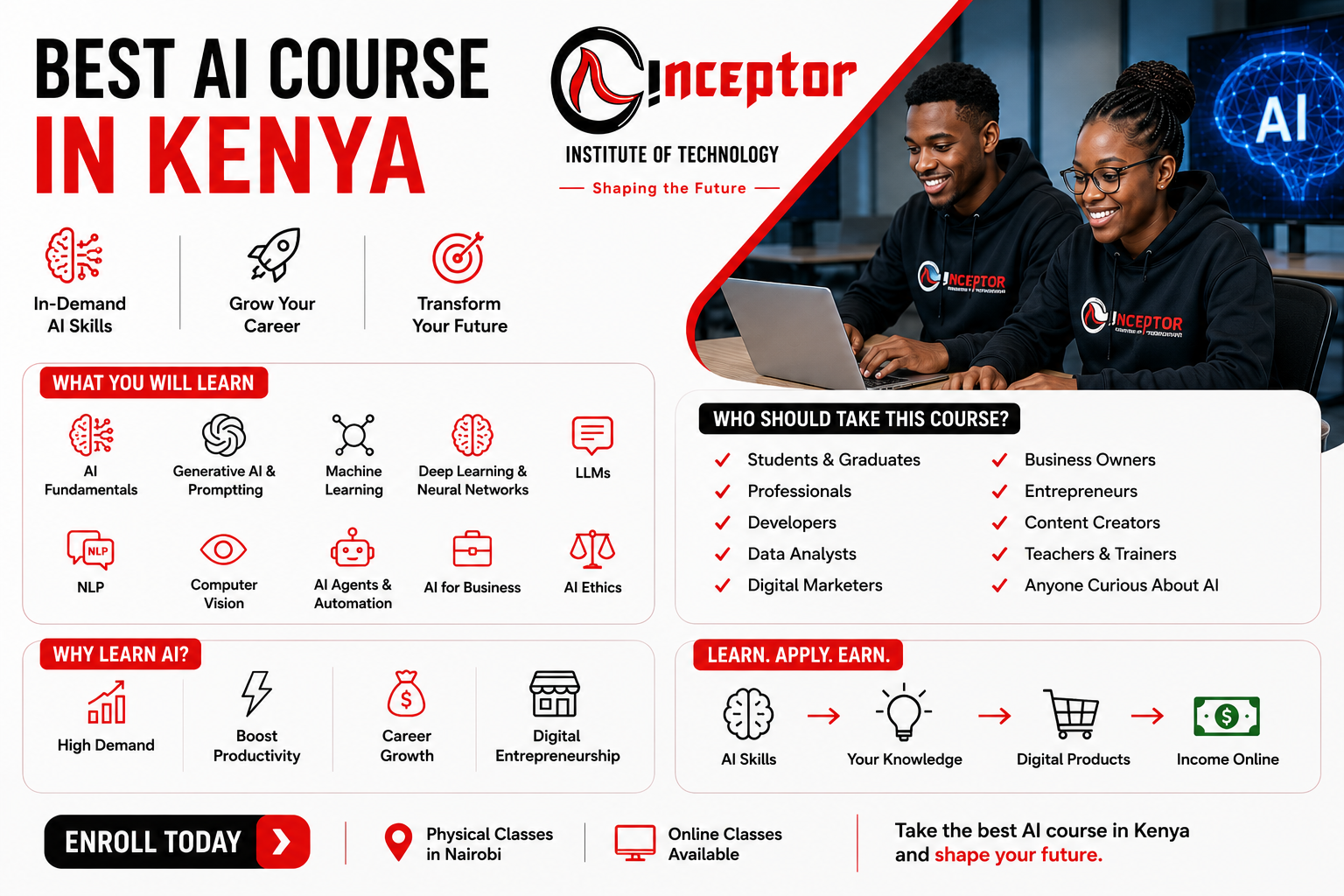
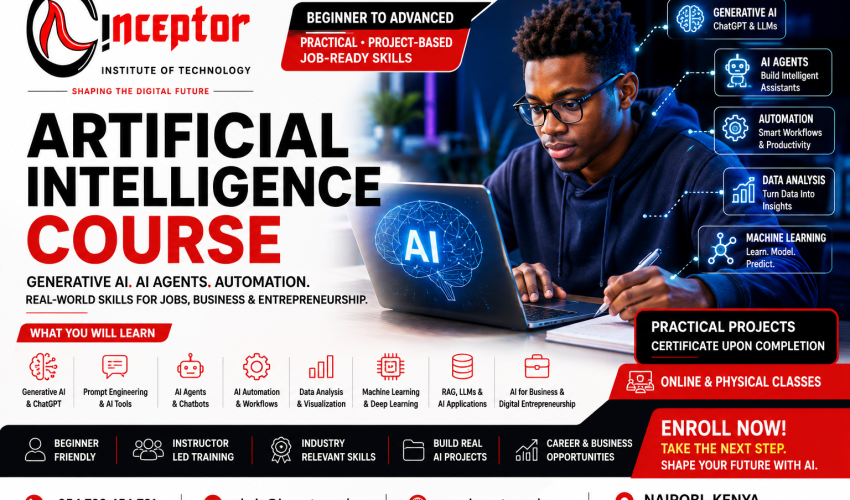
For learners looking for practical instructor-led training, the Artificial Intelligence (AI) Training at Inceptor Institute of Technology in Nairobi provides a structured pathway covering these areas and their application in careers, businesses and digital entrepreneurship.
Quick Answer: What Is the Best AI Course in Kenya?
The best AI course depends on what you want to achieve.
For most beginners and professionals, a comprehensive AI course should teach:
- Artificial Intelligence fundamentals
- Generative AI
- Prompt engineering
- Machine learning
- Deep learning
- Neural networks
- Large Language Models (LLMs)
- Natural Language Processing (NLP)
- Computer vision
- AI agents
- AI automation
- AI tools for productivity
- AI applications in business
- Responsible and ethical AI
- Practical AI projects
Learners interested in these skills can consider the Inceptor Artificial Intelligence Training Course in Nairobi, Kenya, which combines introductory AI concepts with machine learning, generative AI, AI agents, business applications and practical projects.
Why Learn Artificial Intelligence in Kenya?
Kenya is actively developing its Artificial Intelligence ecosystem.
The Kenya National Artificial Intelligence Strategy 2025–2030 identifies AI talent development as an important component of the country’s digital transformation agenda. One of its stated goals is to develop a robust pipeline of competent AI professionals.
This means learning AI is increasingly relevant not only for software developers and data scientists but also for professionals in business, marketing, finance, education, healthcare, agriculture and entrepreneurship.
Globally, the trend is equally significant.
The World Economic Forum’s Future of Jobs Report 2025 identifies AI and big data among the fastest-growing skills toward 2030.
For Kenyan learners, acquiring practical AI skills therefore provides opportunities to participate in both the local and international digital economy.
What Should a Good AI Course in Kenya Teach?
When comparing Artificial Intelligence courses in Kenya, avoid choosing a program simply because it has “AI” in its title.
Look carefully at the curriculum.
A comprehensive AI training program should ideally cover the following areas.
1. Artificial Intelligence Fundamentals
Beginners should first understand:
- What Artificial Intelligence is
- How AI works
- Different types of AI
- Traditional AI vs generative AI
- Common AI applications
- Limitations of AI
- How organizations use AI
Understanding these concepts creates the foundation needed before progressing into more advanced technologies.
2. Generative AI
Generative AI has made Artificial Intelligence accessible to millions of people who are not programmers.
Learners should understand how generative AI systems can create and manipulate:
- Text
- Images
- Video
- Audio
- Code
- Research
- Data
- Documents
They should also learn how tools such as ChatGPT and other generative AI platforms can be incorporated into practical workflows.
3. Prompt Engineering
Knowing how to communicate effectively with AI systems is becoming an important digital skill.
Prompt engineering involves designing instructions that help AI systems generate more accurate and useful outputs.
Learners should understand:
- Prompt structure
- Context setting
- Role prompting
- Few-shot prompting
- Iterative prompting
- Research prompts
- Business prompts
- Content-generation prompts
- Data-analysis prompts
- AI workflow prompts
The objective should not simply be learning a collection of prompts. Students should understand why different prompting techniques work and when to use them.
4. Machine Learning
Machine learning is one of the foundations of modern Artificial Intelligence.
A strong AI course should introduce learners to concepts such as:
- Supervised learning
- Unsupervised learning
- Training data
- Classification
- Regression
- Prediction
- Model training
- Model evaluation
Students interested in becoming AI engineers, data scientists or machine-learning specialists will eventually need deeper technical knowledge in this area.
5. Deep Learning and Neural Networks
Deep learning powers many sophisticated AI applications.
Students should be introduced to:
- Neural networks
- Deep learning
- Training models
- Pattern recognition
- Image recognition
- Speech recognition
This helps learners understand the technology behind many AI systems rather than simply learning how to operate AI tools.
6. Large Language Models
Large Language Models, commonly called LLMs, power many modern AI assistants and generative AI applications.
Learners should understand concepts such as:
- What LLMs are
- How LLMs are trained
- Tokens and context
- Foundation models
- AI hallucinations
- Retrieval-Augmented Generation (RAG)
- AI assistants
- LLM applications
These concepts are becoming increasingly important for anyone interested in developing AI-powered applications.
7. Natural Language Processing
Natural Language Processing, or NLP, enables computers to work with human language.
It is used in applications including:
- Chatbots
- Translation
- Sentiment analysis
- Search engines
- Customer support
- Voice assistants
- Document analysis
NLP therefore has applications across many industries.
8. Computer Vision
Computer vision allows AI systems to interpret images and video.
Applications include:
- Facial recognition
- Medical imaging
- Manufacturing
- Security systems
- Agriculture
- Autonomous vehicles
- Image classification
Students pursuing advanced AI careers should understand the fundamentals of computer vision.
9. AI Agents and Automation
AI is increasingly moving from simply answering questions to performing multi-step tasks.
This has created growing interest in AI agents.
AI agents can potentially interact with software, retrieve information, analyse data and execute workflows based on defined objectives and permissions.
Businesses can use AI automation in areas such as:
- Customer support
- Marketing
- Lead management
- Research
- Reporting
- Data processing
- Administrative tasks
- E-commerce
Learning how AI automation works can therefore be useful for both employees and entrepreneurs.
10. AI Earning Opportunities
What next after gaining the AI skills? Monetization. Learning the skill is not enough, understanding what you do with the skills to acquire a job or make money is necessary.
Best AI Course in Nairobi for Beginners
You do not necessarily need to be a programmer before you start learning Artificial Intelligence.
Beginners can start with:
AI fundamentals → Generative AI → Prompt Engineering → AI Tools → AI Automation → Machine Learning Fundamentals → AI Projects
Programming can then be introduced as learners move toward technical AI development.
This approach makes AI accessible to students from different academic and professional backgrounds.
The Inceptor AI Training Course in Nairobi is structured to accommodate learners interested in developing practical AI knowledge while progressively exploring more advanced concepts.
AI Training at Inceptor Institute of Technology
Inceptor Institute of Technology offers practical Artificial Intelligence training in Nairobi designed for learners interested in understanding and applying modern AI technologies.
The current program covers areas including:
- Artificial Intelligence fundamentals
- Generative AI
- Machine learning
- Deep learning
- Neural networks
- Large Language Models
- Natural Language Processing
- Computer vision
- AI agents
- Robotics and automation
- AI for business
- AI adoption frameworks
- AI ethics and governance
- AI entrepreneurship
Students also work with practical AI applications and projects rather than relying exclusively on theoretical instruction.
The program is suitable for learners ranging from beginners interested in understanding AI to professionals and entrepreneurs looking for ways to incorporate Artificial Intelligence into their work.
Who Should Take an AI Course?
Artificial Intelligence training is no longer relevant only to computer scientists.
AI courses can benefit:
University and College Students
Students can combine AI skills with their existing areas of study and prepare themselves for increasingly AI-enabled workplaces.
Software Developers
Developers can learn how to integrate AI capabilities into websites, mobile applications, APIs and software products.
Data Analysts
AI and machine learning can help analysts work with larger datasets, identify patterns and develop predictive models.
Digital Marketers
Marketers increasingly use AI for research, content creation, customer segmentation, analytics and marketing automation.
Business Owners
Entrepreneurs can use AI to improve productivity, automate repetitive processes and explore new products and services.
Teachers and Trainers
Educators can use AI to assist with lesson planning, learning resources, assessments and personalized learning experiences.
Content Creators
AI tools can assist creators with research, scripting, graphics, video production and digital-product development.
Job Seekers
Combining AI knowledge with an existing professional skill can help candidates adapt to changing workplace requirements.
Career Opportunities After Learning AI in Kenya
Learning Artificial Intelligence does not automatically guarantee employment. However, developing practical AI skills can prepare learners for emerging and evolving roles such as:
- AI Engineer
- Machine Learning Engineer
- Data Scientist
- Data Analyst
- AI Automation Specialist
- Generative AI Specialist
- AI Application Developer
- NLP Engineer
- Computer Vision Engineer
- AI Consultant
- AI Digital Product Specialist
- AI Trainer
- AI Solutions Developer
Some positions require advanced programming, mathematics and computer-science knowledge, while others focus more heavily on implementing existing AI technologies.
This is why learners should choose an AI course based on their intended career path.
Can You Make Money With AI Skills in Kenya?
Yes. AI skills can potentially be monetized through employment, freelancing, consulting, entrepreneurship and digital products.
For example, a learner could develop skills in AI-assisted:
- Content creation
- Business automation
- Chatbot development
- Data analysis
- Digital marketing
- Graphic design
- Video production
- Website development
- Research
- Online training
- Digital product creation
Someone with professional knowledge can also combine that expertise with AI.
A teacher, for example, could use AI tools to help create revision resources or educational micro-courses. A marketer could build AI-assisted marketing systems. A developer could build AI-powered applications.
The strongest opportunities often emerge from combining AI + another valuable skill or industry specialization.
AI and Digital Entrepreneurship
One particularly interesting opportunity is using Artificial Intelligence to create digital businesses.
Instead of treating AI only as a pathway to employment, learners can use it to help research, develop and market digital products.
Examples include:
- E-books
- How-to guides
- Online courses
- Micro-courses
- Video tutorials
- Business templates
- AI prompt packs
- Checklists
- Educational resources
- Design templates
- Software tools
For example, someone who understands poultry farming could use AI to assist with researching, structuring and designing a practical poultry-farming guide.
A teacher could package revision materials into a digital study guide.
A graphic designer could create reusable business templates.
The underlying expertise still matters; AI primarily helps accelerate parts of the research, production and marketing process.
This is one reason Inceptor increasingly combines technology training with practical digital entrepreneurship.
How to Choose the Best AI Training Institute in Kenya
Before enrolling for an Artificial Intelligence course, evaluate the training provider carefully.
Consider the following:
Curriculum: Does the program teach modern AI technologies or only basic computer skills?
Practical projects: Will you actually build or implement something?
Instructor support: Can you interact with trainers when you encounter problems?
Beginner accessibility: Is there an appropriate starting point if you do not have an AI or programming background?
Advanced progression: Can you progress into machine learning, LLMs, NLP, computer vision or automation?
Business applications: Does the training demonstrate how organizations actually use AI?
Career relevance: Does the curriculum connect skills to realistic professional opportunities?
Responsible AI: Does the program address privacy, hallucinations, bias, ethics and responsible AI usage?
The best AI course in Kenya is ultimately the course that matches your starting level and intended outcome while providing enough practical work for you to demonstrate what you have learned.
AI Course in Kenya: Online or Physical Classes?
Both learning formats have advantages.
Online AI courses provide flexibility and can be suitable for learners outside Nairobi.
Physical instructor-led classes provide direct interaction with trainers and other students.
A blended approach can offer the advantages of both.
Learners should therefore consider:
- Their location
- Available study time
- Internet connectivity
- Preferred learning style
- Need for instructor support
- Practical laboratory requirements
Inceptor provides learners with options for accessing practical technology training while its Nairobi location supports students who prefer physical instruction.
Do I Need Coding to Learn Artificial Intelligence?
Not necessarily.
Beginners can learn:
- Generative AI
- Prompt engineering
- AI productivity tools
- AI research
- AI automation concepts
- AI business applications
without advanced programming.
However, anyone intending to become an AI engineer, machine-learning engineer or advanced AI developer should expect to learn programming.
Python is particularly important because of its extensive ecosystem for machine learning, data science and Artificial Intelligence.
How Long Does It Take to Learn AI?
There is no single timeframe because “learning AI” can mean very different things.
Someone learning how to use generative AI effectively may become productive relatively quickly.
Learning machine learning, neural networks, mathematics, Python and advanced AI engineering takes considerably longer.
A structured learning pathway might look like:
Stage 1: AI fundamentals
Stage 2: Generative AI and prompting
Stage 3: AI tools and automation
Stage 4: Python and data fundamentals
Stage 5: Machine learning
Stage 6: Deep learning
Stage 7: LLMs, NLP and computer vision
Stage 8: Portfolio projects and specialization
The important factor is not simply completing lessons. It is being able to apply what you have learned to real problems.
Is Artificial Intelligence a Marketable Skill in Kenya?
AI is increasingly becoming a valuable complementary skill across multiple occupations.
Kenya’s National AI Strategy emphasizes AI talent development, while international labour-market research points toward increasing demand for AI and big-data capabilities.
Rather than thinking of AI as a single profession, learners should consider combinations such as:
AI + Software Development
AI + Data Analytics
AI + Cybersecurity
AI + Digital Marketing
AI + Finance
AI + Education
AI + Agriculture
AI + Business
AI + Content Creation
AI + Digital Entrepreneurship
These combinations can be more valuable than learning isolated AI tools.
Frequently Asked Questions About AI Courses in Kenya
Which is the best AI course in Kenya?
The best AI course depends on your objective. A comprehensive program should cover AI fundamentals, generative AI, machine learning, LLMs, automation and practical projects. Inceptor Institute of Technology offers an Artificial Intelligence training program in Nairobi covering these areas.
Where can I study Artificial Intelligence in Kenya?
AI can be studied through universities, colleges, technology training institutes and online platforms. Learners looking for practical instructor-led AI training can consider Inceptor Institute of Technology in Nairobi.
Can a beginner learn Artificial Intelligence?
Yes. Beginners can start with AI fundamentals, generative AI and practical AI tools before progressing to programming, machine learning and advanced AI development.
Do I need mathematics to learn AI?
Basic AI applications and generative AI tools do not require advanced mathematics. However, machine learning, deep learning and AI research increasingly require knowledge of statistics, probability, linear algebra and related mathematical concepts.
Do I need Python for Artificial Intelligence?
You can begin learning AI without Python. However, Python becomes important when progressing into machine learning, data science and AI application development.
Is AI a good career in Kenya?
AI-related skills are becoming increasingly relevant as organizations adopt data, automation and generative AI technologies. Career prospects are strongest when AI knowledge is combined with programming, data, business or industry-specific expertise.
Can I learn AI online in Kenya?
Yes. Many introductory and advanced AI programs can be studied online. Instructor-led online learning can be particularly useful for learners who need guidance while studying remotely.
Can I use AI skills to start a business?
Yes. AI can support business automation, consulting, software development, content production, digital marketing and digital-product creation. Successful businesses still require genuine customer demand, useful expertise and effective execution.
How Can You Benefit From Learning AI?
Learning Artificial Intelligence can benefit you beyond simply qualifying for an AI-related job. Once you understand generative AI, prompt engineering, AI automation, content creation and practical AI tools, you can combine these skills with knowledge you already have to create additional income opportunities. You could use AI skills for employment, freelancing, business automation, consulting, training others, or creating and selling digital products such as e-books, practical guides, templates, prompt packs, video tutorials and micro-courses. Instead of depending entirely on job opportunities, learners can use AI to help package their existing knowledge into useful digital products and build an online digital business.
Example: Turning an Existing Skill Into a Digital Product
Consider Mary, a trained accountant in Nairobi who understands small-business bookkeeping but has never created a digital product. After learning how to use AI effectively, she could identify a common problem among small businesses: many owners struggle to track daily sales, expenses and profits. Mary could use her accounting expertise together with AI to research common questions, organize her knowledge and create a practical “Small Business Bookkeeping Starter Kit.” The product might contain an expense-tracking spreadsheet, cash-flow template, simple bookkeeping guide and a short video tutorial showing business owners how to use them. AI can assist her with structuring the guide, improving explanations, developing examples, designing marketing content and preparing the product for online distribution. Mary remains the subject-matter expert, AI helps her produce and package that expertise more efficiently.
She could then sell the digital product online through a digital-products marketplace such as Vezill, promote it through Google search, social media and content marketing, and potentially sell the same downloadable product repeatedly without recreating it for every customer. Alternatively, she could create a 30–60 minute micro-course teaching bookkeeping for small businesses, sell access to the training, or offer paid online training sessions. This illustrates an important opportunity for AI learners: Learn AI → Combine AI with an existing skill → Solve a specific problem → Create a digital product or training → Sell it online → Improve and scale based on customer demand.
This model can apply to many professions. A teacher could create revision resources or micro-courses; a farmer could package practical farming knowledge into guides and tutorials; a digital marketer could create marketing templates and training; a graphic designer could develop reusable design resources; and an IT professional could create technology tutorials, checklists or online courses. In this way, learning AI can support both career development and digital entrepreneurship, enabling learners to turn useful knowledge and skills into products or training that can reach customers beyond their immediate location.
AI + Skills + Digital Product Trading
An AI learner can therefore follow a simple practical pathway:
Learn AI skills → Identify a problem people will pay to solve → Apply your existing knowledge → Use AI to accelerate creation → Package the solution as a digital product or training → List and market it online → Earn from sales and continue improving the product.
The key is that AI does not replace expertise or guarantee income. It makes researching, creating, packaging, marketing and improving useful digital products significantly more efficient when combined with genuine knowledge and a validated customer problem.
Start Learning Artificial Intelligence in Kenya
Artificial Intelligence is rapidly changing how people learn, work, create and operate businesses.
For Kenyan learners, the opportunity is not simply to learn how to use individual AI tools. The bigger opportunity is to understand how Artificial Intelligence works and how to apply it to real problems.
Whether your objective is employment, career advancement, freelancing, entrepreneurship or developing AI-powered products, start with strong fundamentals and progress toward practical projects.
Inceptor Institute of Technology’s Artificial Intelligence Training in Nairobi, Kenya provides a structured pathway covering Artificial Intelligence fundamentals, generative AI, machine learning, AI agents, business applications and emerging AI technologies.
Explore the Inceptor AI Training Course and start building practical AI skills for the changing digital economy.