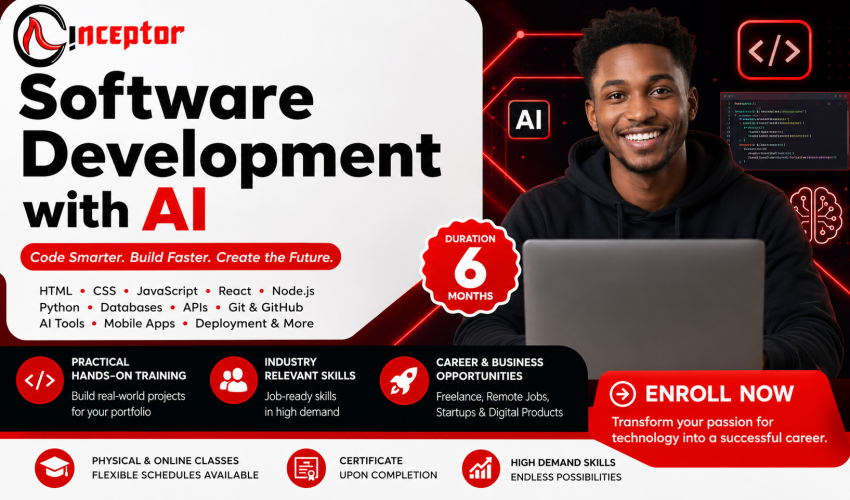
.

What You Will Learn
1. Programming Fundamentals
Start with the foundations required to become a competent software developer.
Learn:
- How computers execute programs
- Variables and data types
- Operators
- Conditional statements
- Loops
- Functions
- Arrays and data structures
- Object-oriented programming
- Algorithms
- Problem solving
- Error handling
- Writing clean and maintainable code
You will learn how to think like a programmer instead of simply copying code.
2. AI-Assisted Coding & Prompt Engineering for Developers
Learn how professional developers can use AI throughout the software development lifecycle.
You will practice using AI to:
- Generate starter code
- Explain complex code
- Debug programming errors
- Refactor existing code
- Generate functions
- Create documentation
- Generate test cases
- Write unit tests
- Analyse errors
- Understand unfamiliar codebases
- Brainstorm application architecture
- Generate database structures
- Build APIs
- Improve application interfaces
- Review code for possible problems
- Accelerate repetitive programming tasks
You will also learn one of the most important AI-era developer skills:
How to verify AI-generated code instead of blindly trusting it.
3. Front-End Web Development
Learn how to build modern interfaces that users interact with.
Technologies may include:
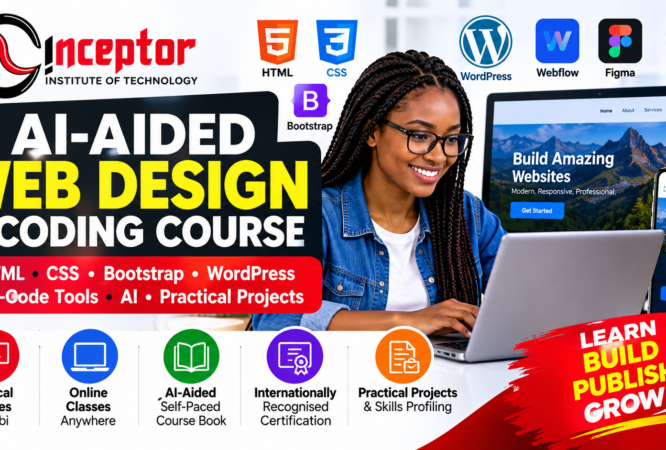
- HTML5
- CSS3
- JavaScript
- Bootstrap
- Responsive Web Design
- React
- UI/UX fundamentals
You will build interfaces that work across desktops, tablets and smartphones.
4. JavaScript Development
JavaScript is one of the core technologies behind modern web applications.
Learn:
- JavaScript fundamentals
- DOM manipulation
- Events
- Functions
- Objects
- Arrays
- ES6+
- Asynchronous JavaScript
- Fetch API
- JSON
- Working with APIs
- Modern JavaScript development
You will progress from basic scripts to interactive applications.
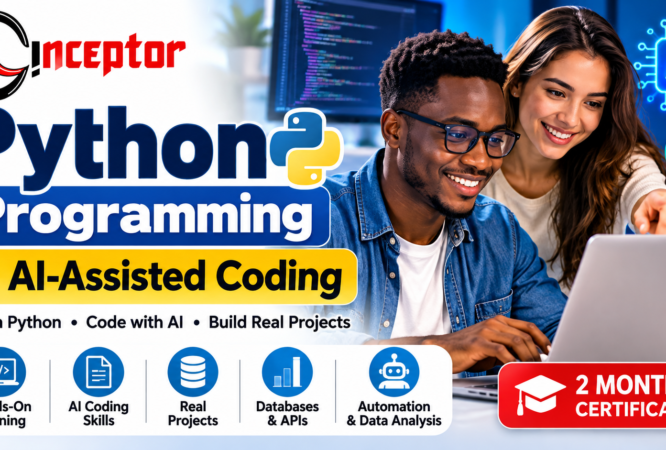
5. Python Programming with AI
Learn Python programming for software development, automation and backend programming.
Topics include:
- Python syntax
- Variables and data structures
- Functions
- Object-oriented programming
- File handling
- Error handling
- Modules and packages
- APIs
- Database connectivity
- Automation
- Backend development
Learners will also use AI development tools to accelerate Python coding, debugging and testing.
6. Back-End Development
A professional software developer needs to understand what happens behind an application’s interface.
Learn how to build the logic that powers modern applications.
Topics include:
- Server-side programming
- Application architecture
- Authentication
- User management
- Sessions
- CRUD applications
- APIs
- Business logic
- Database integration
- Security fundamentals
- Backend frameworks
7. Database Development
Applications need somewhere to store information.
Learn how to design and manage databases using technologies such as:
- MySQL
- SQL
- Relational databases
- Database modelling
- Tables and relationships
- Queries
- Data validation
- CRUD operations
- Connecting databases to applications
You will build applications that can securely create, retrieve, update and manage information.
8. API Development & Integration
APIs allow applications to communicate with other systems.
Learn how to:
- Understand REST APIs
- Create APIs
- Consume third-party APIs
- Work with JSON
- Test API endpoints
- Connect front-end and back-end systems
- Integrate payment, messaging, mapping and AI services
API knowledge opens opportunities for building much more powerful software products.
9. Building AI-Powered Applications
You won’t only use AI to write code.
You will learn how software developers can add AI capabilities to applications.
Depending on the project, learners may explore applications such as:
- AI chatbots
- Customer-support assistants
- Document assistants
- Content-generation applications
- Recommendation systems
- AI-powered business tools
- Intelligent search systems
- Automated workflow applications
This introduces learners to the growing field of AI application development.
10. Mobile App Development
Learn the principles behind creating applications for smartphones and mobile devices.
Topics may include:
- Mobile application architecture
- Flutter
- Cross-platform application development
- User interfaces
- Forms and navigation
- API integration
- Databases
- Authentication
- Testing
- Application deployment
Students can build applications addressing real Kenyan and global problems.
11. Git, GitHub & Collaborative Development
Modern developers need version-control skills.
Learn:
- Git fundamentals
- GitHub
- Repositories
- Commits
- Branches
- Pull requests
- Version control
- Team collaboration
- Managing software projects
Your GitHub profile can also become an important part of your professional developer portfolio.
12. Software Testing, Debugging & Quality Assurance
Writing code is only part of software engineering.
You will learn how to make software reliable.
Topics include:
- Debugging techniques
- Unit testing
- Functional testing
- Error handling
- Code review
- AI-assisted testing
- Performance considerations
- Software quality assurance
13. Software Security Fundamentals
Developers must understand how to avoid common security mistakes.
Learn fundamental concepts around:
- Secure authentication
- Password handling
- Input validation
- Database security
- Application permissions
- Secure APIs
- Common web vulnerabilities
- Secure coding practices
14. Cloud Deployment & DevOps Fundamentals
Building an application is not enough.
People need to be able to use it.
Learn the fundamentals of:
- Hosting applications
- Domains
- Cloud platforms
- Environment variables
- Application deployment
- Production databases
- Basic CI/CD concepts
- Application monitoring
- Maintaining deployed applications
Students learn how to take an application from their laptop to the internet.
Build Real Software Projects
Software development is best learned by building.
Throughout the course, students work on practical applications that can become part of their professional portfolio.
Projects may include:
Business Management System
Build a system that manages customers, products, sales or business records.
E-Commerce Application
Develop an online store with products, user accounts, shopping functionality and database integration.
School or Student Management System
Create an application for managing students, courses, results or attendance.
Mobile Application
Design and develop a functional mobile application solving a specific problem.
AI-Powered Application
Build an application incorporating AI functionality such as a chatbot, intelligent assistant or automated content-processing tool.
Final Capstone Project
Identify a real problem and design, develop, test and deploy a complete software solution.
Your final projects become part of your software developer portfolio.
Software Development Career Opportunities
Completing the course can prepare learners to pursue opportunities such as:
Software Developer — Develop software applications for businesses, startups and organisations.
Full-Stack Developer — Build both front-end interfaces and back-end application systems.
Front-End Developer — Specialise in interactive web interfaces and user experiences.
Back-End Developer — Build servers, databases, APIs and application logic.
Python Developer — Build applications, automation solutions, APIs and backend systems using Python.
JavaScript/React Developer — Develop modern interactive web applications.
Mobile App Developer — Build Android and cross-platform mobile applications.
AI Application Developer — Create applications that integrate artificial intelligence capabilities.
API Developer — Build and integrate APIs connecting different software platforms.
Junior Software Engineer — Join development teams building and maintaining software products.
Freelance Developer — Build websites, applications, integrations and business systems for clients.
Technology Entrepreneur — Create your own applications, SaaS platforms or digital businesses.
Can Software Developers Work Remotely?
Yes.
Software development is particularly suited to remote work because development, testing, project management and collaboration can all be performed digitally.
A developer in Kenya can potentially work with:
- Kenyan technology companies
- Startups
- NGOs
- Banks
- E-commerce companies
- International organisations
- Overseas development teams
- Remote clients
- Freelance marketplaces
However, completing a course alone does not guarantee employment. Employers and clients commonly evaluate practical ability, portfolio quality, problem-solving skills, communication and experience alongside qualifications.
That is why this course emphasises projects and portfolio development.
How Can You Make Money with Software Development Skills?
Software development does not limit you to looking for a salaried job.
There are several possible income paths.
1. Freelance Software Development
You can develop applications for businesses and individuals.
For example, suppose a small wholesale business needs a simple inventory and sales management system.
Instead of relying entirely on spreadsheets, you could develop a web-based application that records products, stock levels, customers and sales.
That becomes a paid software-development project.
2. Build Websites and Web Applications for Businesses
Many organisations require:
- Company websites
- Booking platforms
- E-commerce websites
- Membership systems
- Customer portals
- Inventory applications
- School systems
- Property management platforms
Each business problem represents a potential development opportunity.
3. Build Mobile Apps
A learner could identify a local problem and create an application around it.
Examples include:
- Delivery applications
- School applications
- Agriculture apps
- Expense trackers
- Booking applications
- Learning apps
- Business management apps
The application can then become a commercial product rather than simply a classroom project.
4. Create SaaS Products
Software as a Service (SaaS) allows developers to build software once and provide access to many customers, usually through subscriptions.
For example:
Imagine you develop a simple appointment and customer-management platform for salons.
Instead of selling the entire system to one salon, you could offer it to multiple salons for a monthly subscription.
This demonstrates an important shift:
Software development can become a business asset, not merely an employment skill.
5. Build and Sell Digital Software Products
Developers can also create digital products such as:
- Website templates
- Application templates
- Source-code projects
- WordPress plugins
- Automation scripts
- Software utilities
- APIs
- Developer tools
- Mobile applications
- SaaS applications
- Programming tutorials
- Coding courses
- Development guides
A developer therefore has the opportunity to turn technical knowledge into reusable digital assets that can be sold repeatedly.
6. Teach Software Development
Once you have developed strong practical experience, you can package your knowledge into:
- Coding tutorials
- Micro-courses
- E-books
- Programming guides
- Video courses
- Workshops
- Mentorship programs
Your software-development knowledge itself can become a digital product.
7. Build Your Own Technology Startup
Perhaps the biggest opportunity is learning to turn an idea into working software.
Instead of paying another developer to build every idea you have, software-development skills allow you to prototype and test your own products.
AI further reduces the barrier by helping developers prototype, document, test and iterate faster.
You could build solutions for sectors such as:
- Education
- Agriculture
- Healthcare
- Finance
- E-commerce
- Logistics
- Real estate
- Tourism
- Retail
- Professional services
A Realistic Example: From Student to Software Entrepreneur
Consider a learner who notices that several small shops struggle to manage inventory.
During the course, the learner builds a simple inventory-management application as a final project.
The system allows businesses to:
- Add products
- Record sales
- Monitor remaining stock
- Identify low-stock products
- Generate basic reports
Instead of leaving the project on a laptop after graduation, the learner approaches several small businesses and demonstrates the software.
The developer could charge businesses for installation, customisation, maintenance or access to an online version.
The same core application can potentially serve multiple customers.
That is the entrepreneurial opportunity software development creates.
Who Should Take This Course?
The Software Development with AI Course is suitable for:
- KCSE graduates exploring technology careers
- University and college students
- ICT and computer science students seeking practical skills
- Complete beginners interested in coding
- Career changers
- Entrepreneurs
- Freelancers
- Web designers wanting to become full-stack developers
- Professionals interested in automation
- Aspiring mobile app developers
- People interested in AI application development
- Anyone who wants to build software products
You don’t need to be an AI expert before joining.
The program starts with the fundamentals and progresses toward practical application development.
Why Study Software Development with AI at Inceptor?
Practical, Project-Based Training
Learn by developing applications rather than relying on theory alone.
AI-Integrated Curriculum
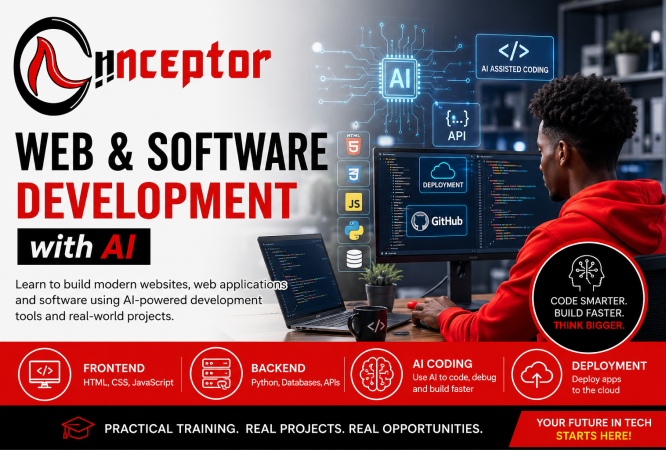
Learn how modern AI development tools fit into coding, debugging, testing, documentation and application development.
Full-Stack Skills
Understand front-end, back-end, databases, APIs and deployment.
Real Portfolio Projects
Build projects that demonstrate your skills to employers and potential clients.
Entrepreneurship Focus
Learn how coding skills can be transformed into freelance services, software products and technology businesses.
Physical & Online Classes
Choose a learning format that fits your circumstances.
Flexible Learning Sessions
Morning, afternoon, evening and weekend learning options can accommodate students and working professionals.
What Will You Be Able to Do After the Course?
By completing the Software Development with AI training, you should be able to:
- Understand programming fundamentals
- Build responsive websites
- Develop full-stack web applications
- Write Python and JavaScript programs
- Develop and integrate APIs
- Work with databases
- Use Git and GitHub
- Develop mobile applications
- Use AI effectively during software development
- Debug and test software
- Integrate AI into selected applications
- Deploy applications online
- Build a professional development portfolio
- Develop software solutions for clients
- Prototype your own digital products
- Continue learning advanced software engineering independently
Frequently Asked Questions
Which is the best software development course in Kenya?
A strong software development course should teach programming fundamentals, front-end and back-end development, databases, APIs, Git/GitHub, software testing, deployment and practical project development. As AI becomes integrated into development workflows, learners should also understand how to use AI coding tools responsibly and effectively.
Inceptor’s Software Development with AI program combines these areas in a practical, project-oriented training environment.
Can I learn software development without previous coding experience?
Yes. Beginners can start with programming fundamentals before progressing to web development, Python, JavaScript, databases, APIs, mobile development and AI-assisted coding.
Is software development still worth learning because of AI?
Yes, but the skill set is evolving. AI can generate code, but developers still need to understand requirements, architecture, databases, security, debugging, testing, integration and whether generated code actually solves the problem correctly.
Learning software development together with AI prepares learners for this changing workflow.
Which programming languages should beginners learn?
JavaScript and Python are useful starting points because they can be applied across web development, backend applications, automation and many other software-development tasks.
The most important goal, however, is understanding programming concepts well enough to learn additional languages and frameworks when required.
Can AI build software for me?
AI can significantly assist software development by generating code, explaining code, creating tests, debugging and helping developers work through technical problems.
However, developers still need to understand and verify generated output, design systems appropriately and ensure applications are secure, reliable and suitable for users.
How long does it take to learn software development?
The time required depends on your starting level, learning intensity and the complexity of applications you want to build. Structured training can establish the foundation, but becoming a strong developer requires continuous practice and building increasingly complex projects.
Can I become a software developer without a computer science degree?
A degree can be valuable, but practical software-development ability can also be demonstrated through coding skills, GitHub activity, deployed applications and a strong portfolio. Learners should focus on building evidence of what they can actually create.
Can software developers make money online?
Yes. Potential routes include remote employment, freelance development, website and application development, SaaS products, mobile apps, templates, plugins, automation scripts, coding courses and other digital products.
Income is not guaranteed and depends on skill level, market demand, portfolio, customer acquisition and execution.
Does this course teach AI coding?
Yes. AI-assisted development is incorporated into the learning process. Students learn how AI can assist with code generation, explanation, debugging, refactoring, documentation and testing while developing the technical knowledge required to verify AI-generated output.
What projects will I build?
Learners work on practical projects that may include websites, database applications, APIs, business management systems, mobile apps and AI-enabled applications, culminating in a portfolio-ready capstone project.
Start Your Software Development Career with AI
The future of software development isn’t AI versus programmers.
It is increasingly about developers who understand programming and know how to use AI effectively.
If you want to build applications, become a software developer, work remotely, freelance, create digital products or launch your own technology business, this course gives you a practical foundation for getting started.
Learn. Code. Build. Deploy. Innovate.
Join the Software Development with AI Course at Inceptor Institute of Technology.
Build real projects, develop a professional portfolio and learn how to transform software-development skills into career and entrepreneurial opportunities.
Apply for the next intake today.
Need Financial Aid? Apply for Scholarship HERE
Course Timing: We have flexible daytime Morning, Afternoon & Evening Sessions (7am-9am, 9am-12pm, 2pm-5pm, 5.30pm- 8pm) and weekend classes.
No of slots: 30 per cohort (We maintain an admission limit of 30 students for every cohort. This is aimed at guaranteeing quality learning and great personalized experience during the training process)