Starting an online business in Kenya does not necessarily require an office, large stock, expensive equipment or thousands of shillings in startup capital.
What you do need is something people are willing to pay for, a practical way to reach those people, a system for receiving payment and a reliable method of delivering what you sell.
For some people, the easiest starting point is freelancing or an online job. For others, it may be selling digital products, offering services, tutoring, e-commerce, content creation or building a small digital business.
This guide explains the different options and gives you a practical roadmap for getting started in Kenya.
Quick Answer: How Can You Start Making Money Online in Kenya?
There are three main routes:
Get an online job
You work remotely for an employer or organization and receive a salary or agreed payment.
Sell a skill or freelance service
You find clients and get paid for specific work such as graphic design, virtual assistance, writing, web development or social media management.
Build an online business
You create a product, service or system that can generate sales repeatedly—for example digital products, e-commerce, consulting, online training or software.
These models are related, but they are not the same.
If you need income quickly and already have a marketable skill, freelancing may be easier to start than trying to build a large online business immediately.
If your objective is to build an asset that can potentially generate repeat sales, a digital business may be more suitable.
Online Job vs Freelancing vs Online Business
Understanding the difference can save you months of confusion.
You can also combine them.
For example, a graphic designer might start by freelancing, then sell Canva templates, teach design online and eventually build a digital-products business.
15 Online Business and Work Ideas You Can Start in Kenya
Virtual Assistant Services
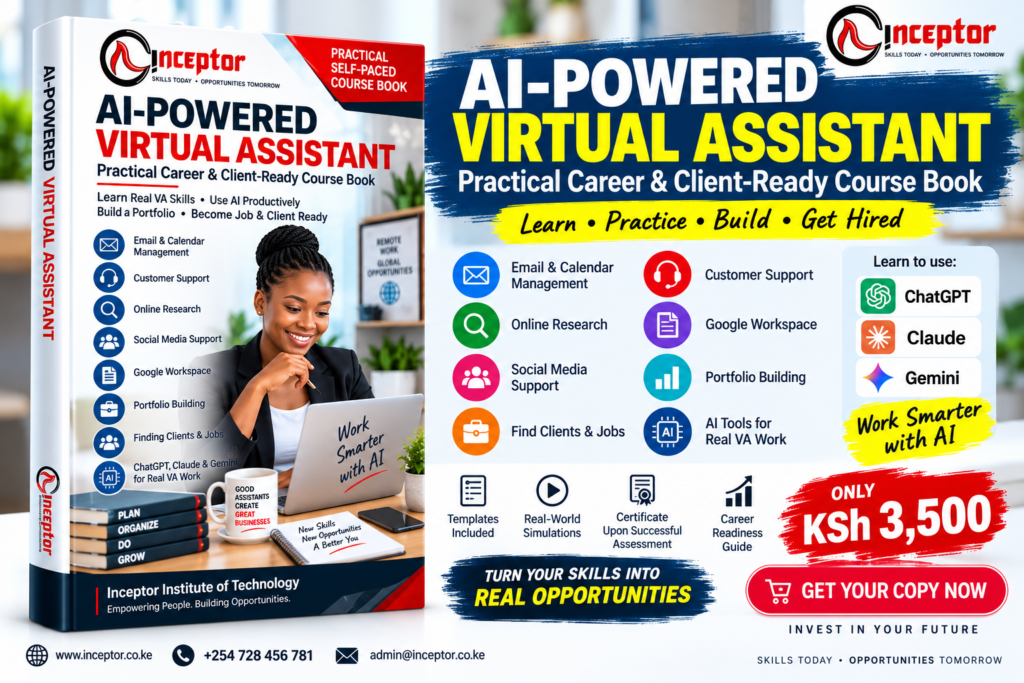
A virtual assistant helps businesses or professionals perform tasks remotely.
Typical services include:
Email management
Scheduling
Internet research
Data entry
Customer support
Social media management
Preparing documents
Updating spreadsheets
CRM management
This can be particularly suitable for someone with good computer, communication and organizational skills.
How to start
Choose three to five tasks you can perform confidently.
Create a simple portfolio showing examples of your work, then approach businesses or search freelance and remote-work platforms.
Businesses, publishers and website owners still need people who can research, structure, edit and improve content.
Possible services include:
Website copy
Blog articles
Product descriptions
Reports
Editing
Proofreading
Email copy
Social media content
AI has changed this industry, so simply producing generic text is becoming less valuable.
A stronger positioning is to combine AI with research, fact-checking, subject knowledge, editing and human judgment.
Graphic Design
If you know Canva, Adobe tools or similar software, you can offer:
Posters
Social media graphics
Business cards
Company profiles
Presentations
Menus
Product catalogues
YouTube thumbnails
Digital-product covers
Instead of saying:
“I am a graphic designer.”
Create a specific offer such as:
“I create professional social-media graphics for restaurants and small businesses.”
Specific offers are usually easier for potential customers to understand.
Need to Learn Quick Graphic Design Skills? Apply HERE
Sell Digital Products
Digital products are items that customers can purchase and receive electronically.
Examples include:
PDF guides
Checklists
Templates
Spreadsheets
Revision materials
Business tools
Prompt packs
E-books
Workbooks
Printable planners
Short courses
Professional resource packs
One advantage is that you create the product once and can potentially sell the same file repeatedly.
However, the product still needs to solve a real problem.
A PDF titled “Business Tips” is vague.
A resource called “30-Day Customer Follow-Up System for Small Businesses” communicates a much clearer result.
The strongest digital products generally help customers do something, understand something, avoid a mistake or achieve a specific outcome.
Need to learn how to create and sell digital products professionally?
Many Kenyan businesses have Facebook, Instagram or TikTok accounts but lack the time or skills to manage them consistently.
You can offer:
Content planning
Creating posts
Short-form video editing
Replying to enquiries
Scheduling posts
Basic advertising support
Monthly performance reports
A good starting strategy is to specialize.
For example:
Social media management for restaurants
may be easier to sell than simply:
Social media management for everyone.
Interested in Learning Social media management professionally – Join Inceptor Certification HERE
Website Design
Businesses increasingly need professional websites, landing pages and online stores.
You can learn tools such as WordPress and other no-code website builders before progressing into more advanced development.
Potential customers include:
Schools
Consultants
Hotels
Contractors
Churches
NGOs
Professionals
Shops
Restaurants
Small businesses
Do not sell only “a website.”
Sell the business outcome—for example, helping a business showcase its services, generate enquiries or accept online orders.
Online Tutoring
If you understand a subject well, you can teach it online.
Possible areas include:
Mathematics
Sciences
Languages
KCSE preparation
Computer skills
Coding
Accounting
Professional certifications
AI tools
Classes can be delivered through video meetings, recorded lessons or a combination of both.
Vezill is a good platform to sell your online tutorials and micro courses
AI-Assisted Business Services
Artificial intelligence has created a growing category of services for people who know how to use AI productively.
Instead of selling “AI,” sell an outcome.
For example:
Creating customer-service knowledge bases
Setting up AI-assisted content workflows
Business research
Presentation preparation
Document summarization
AI-assisted marketing systems
Creating business templates
Training employees to use AI tools
Businesses normally care more about the result than the technology used to produce it.
Video Editing
Short-form video has created demand for people who can transform raw footage into usable content.
You can edit:
TikTok videos
Instagram Reels
YouTube Shorts
Interviews
Podcasts
Business adverts
Training videos
Create three to five strong samples before approaching clients.
If you already have professional experience, you may be able to package that knowledge into consulting.
Examples include:
HR consulting
Business consulting
Marketing
IT consulting
Career coaching
Agriculture consulting
Financial education
Operations consulting
The important question is:
What specific problem can your experience help another person solve?
Online Courses and Practical Training
If people repeatedly ask you how to do something, that knowledge may be teachable.
You could create training around:
Excel
AI
Coding
Cybersecurity
Digital marketing
Graphic design
Business skills
Job-search skills
Entrepreneurship
Avoid making a huge course before confirming demand.
Start with a short workshop, guide or mini-course and see whether people are willing to pay for the result.
If you need Help on how to get started- Contact Inceptor Support Team HERE with the skill you can train.
E-Commerce
You can sell physical products through:
Your own website
Social media
Online marketplaces
WhatsApp Business
Potential categories include fashion, beauty products, electronics accessories, household goods and specialized niche products.
Unlike purely digital products, physical e-commerce requires careful attention to:
Stock
Suppliers
Delivery
Returns
Customer service
Payment collection
Product margins
Calculate these costs before assuming that sales equal profit.
Affiliate Marketing
Affiliate marketing means earning a commission when someone purchases a product or service through your referral.
It works best when you already have:
A website
Social media audience
YouTube channel
Newsletter
Community
Strong niche expertise
Avoid programs whose primary attraction is recruiting more members rather than providing genuine customer value.
Content Creation
You can build an audience through:
YouTube
TikTok
Facebook
Instagram
Podcasts
Blogging
Newsletters
Monetization can eventually come from advertising, sponsorships, affiliate marketing, services, memberships or your own products.
Content creation is usually not instant income.
It is better viewed as an audience-building strategy that may become a business over time.
Reselling Licensed Digital Products
Another model is legally reselling digital products where the creator has explicitly provided resale rights.
Some digital products are offered with Master Resell Rights (MRR) or other commercial licences.
Before reselling anything, read the licence carefully.
Confirm:
Whether resale is permitted
Whether you can change the product
Whether you can change the price
Whether buyers receive resale rights
Whether there are geographical or platform restrictions
Never assume that buying a PDF, course, image or template automatically gives you permission to resell it.
Vezill is a digital product trading platform best known for Master Resell Rights Products
Can You Start an Online Business in Kenya Without Money?
Sometimes – but “without money” does not mean without resources.
You will normally still need some combination of:
Smartphone or computer
Internet connection
Time
A marketable skill
Payment method
Communication tools
If you have almost no startup capital, starting with a service is often practical because you do not need to manufacture or purchase stock.
For example, someone who already owns a laptop could learn a marketable skill, create sample work and begin looking for clients.
Profits can later be reinvested into better equipment, advertising, software or a larger business.
How to Start an Online Business in Kenya: Step by Step
Step 1: Choose One Problem
Do not begin with:
“How can I make money online?”
A better question is:
“What problem can I solve for a specific group of people?”
Examples:
Restaurants need more customers.
Job seekers need better CVs.
Small businesses need social media content.
Students need revision materials.
Busy entrepreneurs need administrative assistance.
Start with the problem.
Step 2: Choose Your Customer
Trying to sell to everybody makes marketing difficult.
Define your first customer clearly.
For example:
Instead of:
“I design websites.”
Try:
“I build simple lead-generation websites for Kenyan contractors and service businesses.”
Your customer immediately understands whether the offer is relevant.
Step 3: Create a Simple Offer
Your offer should answer four questions:
Who is this for?What problem does it solve?What exactly does the customer receive?How much does it cost?
You do not need dozens of products when starting.
One clear offer is enough to test the market.
Step 4: Validate Demand Before Investing Heavily
Before spending significant money, check whether people actually want your solution.
Research:
Google searches
Google Trends
Competitors
Social-media discussions
Marketplace listings
Customer questions
Reviews
Facebook groups
Reddit and online communities
Questions people ask AI assistants
Then talk to potential customers.
A simple test is better than months spent developing something nobody wants.
Step 5: Create Proof
Customers need a reason to trust you.
If you are new and have no clients, create demonstration projects.
A web designer can build a sample site.
A writer can publish three excellent articles.
A video editor can edit sample videos.
A virtual assistant can create sample spreadsheets, schedules and administrative workflows.
A digital-product seller can provide preview pages.
Proof reduces uncertainty.
Step 6: Create Your Online Presence
You do not necessarily need an expensive website on day one.
Depending on your business, you can begin with:
WhatsApp Business
LinkedIn
Facebook
Instagram
TikTok
A marketplace profile
A simple landing page
Your online presence should clearly explain:
What you offer + who it helps + how to buy/contact you.
Step 7: Decide How Customers Will Pay
Kenyan businesses commonly use options such as:
M-Pesa
Bank transfer
Debit/credit cards
Online payment gateways
If you serve international customers, you may need additional payment methods depending on the platform and country involved.
Always check transaction fees, withdrawal requirements, supported countries and current terms before choosing a provider.
Step 8: Get Your First Customers
This is where many beginners get stuck.
Do not build something and simply wait for customers.
Use active customer acquisition.
You can:
Contact prospective customers directly
Publish useful content
Ask for referrals
Join relevant communities
Optimize your website for Google
Create educational videos
Build an email list
Use marketplaces
Form partnerships
Run paid advertising once the offer has been validated
Your first objective is not 10,000 customers.
It is one paying customer.
Then learn why that customer bought.
Get the second.
Then improve the process.
Where Can Kenyans Find Legitimate Online Work?
Kenya’s Ajira Digital Programme is one useful starting point for people exploring digital work and training opportunities.
You can also research established freelance platforms, professional networks and remote-job boards.
However, a platform being popular does not mean every listing is genuine.
Verify the employer and opportunity independently before providing sensitive information or making commitments.
How to Avoid Online Job and Online Business Scams
Online-income scams frequently use urgency, guaranteed earnings and unrealistic promises.
Be cautious when someone tells you:
“Earn KSh 10,000 every day guaranteed.”
“Pay first before we give you a job.”
“No skills required—instant income.”
“Recruit five people to unlock earnings.”
“Send money to activate your salary.”
“Guaranteed investment returns.”
Also be cautious about unsolicited WhatsApp and Telegram offers.
Before joining an opportunity, investigate:
Who owns it?What actual product or service creates the revenue?What exactly are you being paid to do?Are independent reviews available?Are the earnings dependent mainly on recruiting new members?
A legitimate business should be able to explain where its revenue comes from.
Do You Need to Register an Online Business in Kenya?
Not everyone testing a freelance skill needs to immediately form a limited company.
However, as your business becomes established, you should understand the appropriate registration, licensing and tax requirements.
Kenya’s Business Registration Service provides online business-registration services through the eCitizen system.
Available structures include business names and companies, among others.
The appropriate structure depends on the nature and scale of your business, ownership and legal requirements.
Check the latest requirements directly on the Business Registration Service rather than relying on old blog posts because government procedures and fees can change.
Get a Step-by-step guide on How to Register a Business Name HERE. Including Master Resell Rights
Do You Pay Tax on Online Income in Kenya?
Online income should not be treated as automatically tax-free simply because it was earned through the internet.
The applicable tax treatment depends on the type of income, business structure, residence and other circumstances.
Keep proper records of:
Sales
Client payments
Platform payments
Business expenses
Invoices
Receipts
Withdrawals
KRA has increasingly integrated electronic records into income and expense validation, making good record-keeping particularly important for businesses.
For your exact obligations, use current KRA guidance or consult a qualified tax professional.
What Online Business Is Best for Beginners in Kenya?
There is no single business model that is best for everybody.
A useful way to choose is:
If you have a skill but little money:
Start with freelancing or services.
If you have useful knowledge:
Consider consulting, tutoring, training or digital products.
If you understand products and logistics:
Consider e-commerce.
If you enjoy building an audience:
Consider content creation.
If you understand technology:
Consider web development, software, automation or AI-enabled services.
If you already have professional experience:
Package that experience into a specialized service, consulting offer or practical knowledge product.
Choose based on the intersection of:
Skills + Customer Problem + Demand + Ability to Deliver.
How to Start an Online Business Using Digital Products
Digital products are particularly interesting for beginners because distribution costs can be relatively low.
Suppose you know how to prepare someone for a particular professional exam.
Instead of repeatedly explaining the same process individually, you could package the knowledge into:
A step-by-step guide
Checklist
Templates
Practice exercises
Video explanation
You now have a product that can potentially be sold repeatedly.
The same principle can apply to knowledge about:
Education
Technology
Business
Agriculture
Career development
Software
Professional skills
DIY processes
Productivity
The key is to package useful knowledge around a specific result, rather than creating information for its own sake.
Using Vezill to Sell Digital Knowledge
One option for people creating digital knowledge products is Vezill.
Creators can use a digital marketplace to package and distribute items such as guides, templates, educational resources and other digital products.
Where a product includes Master Resell Rights, buyers may also be permitted to resell it according to the specific licence attached to that product.
See How to Find Problems People Will Pay You to Solve
A Simple 7-Day Online Business Startup Plan
Day 1 — Choose the problem
Identify one problem you can realistically solve.
Day 2 — Research customers
Find 10–20 people or businesses experiencing that problem.
Day 3 — Create the offer
Define exactly what you will provide and set an initial price.
Day 4 — Build proof
Create a sample, demonstration, portfolio or product preview.
Day 5 — Create your sales presence
Set up a professional profile, landing page or marketplace listing.
Day 6 — Find prospects
Identify at least 20 potential customers.
Day 7 — Start selling
Contact prospects or publish your offer and collect feedback.
Do not spend your first month designing logos and business cards while avoiding customers.
Your first important test is simple:
Will someone pay for your solution?
Frequently Asked Questions
What is the easiest online business to start in Kenya?
Online Service businesses such as digital products trading, virtual assistance, graphic design, tutoring, writing, social media management and similar freelance services can have relatively low startup costs if you already have the required equipment and skills.
Can I make money online using my phone in Kenya?
Yes, some activities can be performed using a smartphone, including content creation, social-media management, communication, simple digital-product sales and certain online tasks. More technical work such as programming, advanced design, data analysis and professional video editing is generally easier with a computer.
Are online jobs in Kenya legitimate?
Legitimate online and remote jobs exist, but so do scams. Kenya’s Ajira Digital Programme itself provides digital-work training and opportunities. Always verify individual employers and platforms before accepting work or paying any fees.
What online business can I start with KSh 1,000?
If you already have a smartphone or computer and internet access, consider a skill-based service where the main input is your time and expertise. Use the money for essential buying one or two digital products with master resell rights – that your audience would be interested in and start selling them.
Can students work online in Kenya?
Yes. Students with suitable skills can explore digital products trading, tutoring, design, writing, virtual assistance, content creation, programming and other flexible digital services. Work should be balanced with academic responsibilities.
Do I need a laptop to work online?
Not for every opportunity. Some work can be performed using a smartphone. However, a laptop significantly expands the types of professional work you can undertake.
How do I receive online payments in Kenya?
Payment options depend on the customer and platform. Common options include M-Pesa, bank transfers, cards and supported online payment services. International freelance platforms normally specify their available withdrawal methods.
Can I sell digital products in Kenya?
Yes. Digital products can include guides, templates, workbooks, courses, spreadsheets and other downloadable resources. Ensure you own the content or have the necessary commercial rights to sell it.
How long does it take to make money online?
There is no guaranteed timeframe. Someone with an existing marketable skill and customers may earn relatively quickly, while building a new business, audience or skill can take substantially longer. Avoid anyone promising guaranteed income within a specific number of days.
Which online skills are worth learning?
Useful areas include AI-assisted productivity, virtual assistance, digital marketing, web development, software development, cybersecurity, data analysis, graphic design, video editing, sales and customer support. The right skill depends on the customers you intend to serve.
Start Small, Solve a Real Problem and Improve
The internet gives Kenyans access to customers, employers and markets far beyond their immediate location.
But an online business is still a business.
You need to create value.
You need customers.
You need to communicate clearly.
You need to deliver what you promise.
And you need to manage your money and obligations properly.
Instead of searching endlessly for the “best way to make money online in Kenya,” start with a more useful question:
What useful result can I help someone achieve and will they pay me to help them achieve it?
Find that answer, create a simple offer and test it with real customers.
That is a much stronger foundation for building sustainable online income.