
What Is Artificial Intelligence? A Beginner’s Guide to AI
Artificial Intelligence (AI) is changing how people work, learn, communicate, create content, run businesses, and solve everyday problems. From asking ChatGPT a question and using Google Maps to navigate, to generating images, analysing business data, detecting fraud, and recommending videos, AI is increasingly embedded in the digital tools we use.
But what is artificial intelligence, how does AI work, and how can a complete beginner start using it?
This beginner-friendly guide explains Artificial Intelligence (AI) in simple language, including how it works, the different types of AI, examples of AI in everyday life, popular AI tools, benefits and limitations, and the AI skills worth learning.
Quick Answer: What Is Artificial Intelligence?
Artificial Intelligence (AI) is technology that enables computers and machines to perform tasks that normally require aspects of human intelligence, such as learning, understanding language, recognizing patterns, solving problems, making predictions, and generating content.
The U.S. National Institute of Standards and Technology (NIST), for example, defines AI in terms of machine-based systems that can make predictions, recommendations or decisions based on human-defined objectives.
In simpler terms:
Artificial Intelligence is about making computers capable of doing tasks that appear intelligent.
Instead of programming a computer with a separate rule for every possible situation, many modern AI systems can learn patterns from large amounts of data and use those patterns to produce predictions or responses.
How Does Artificial Intelligence Work?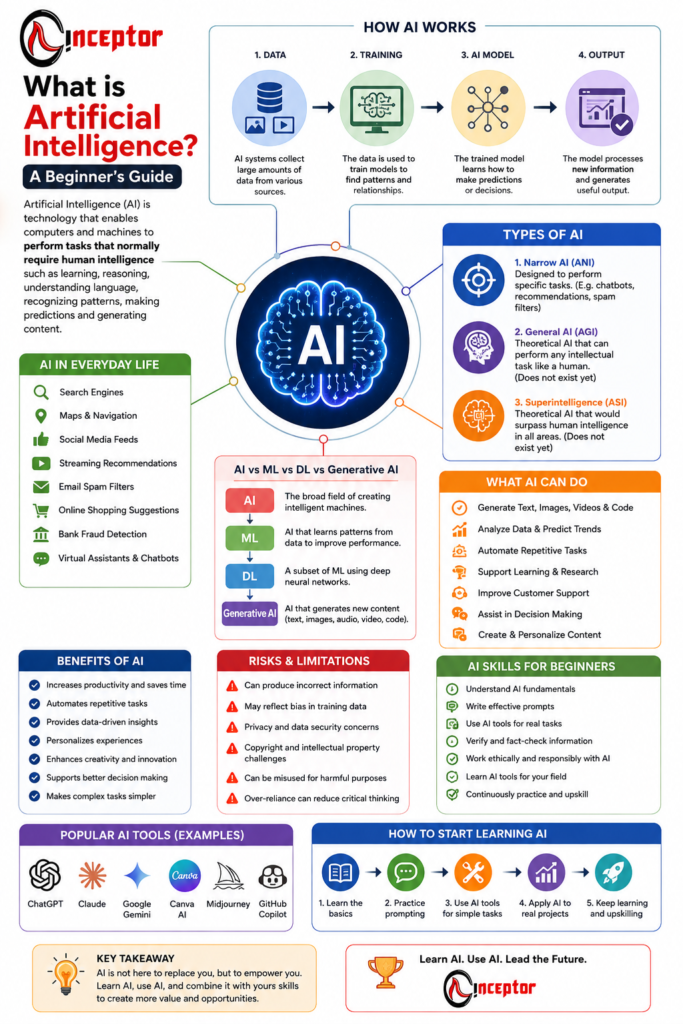
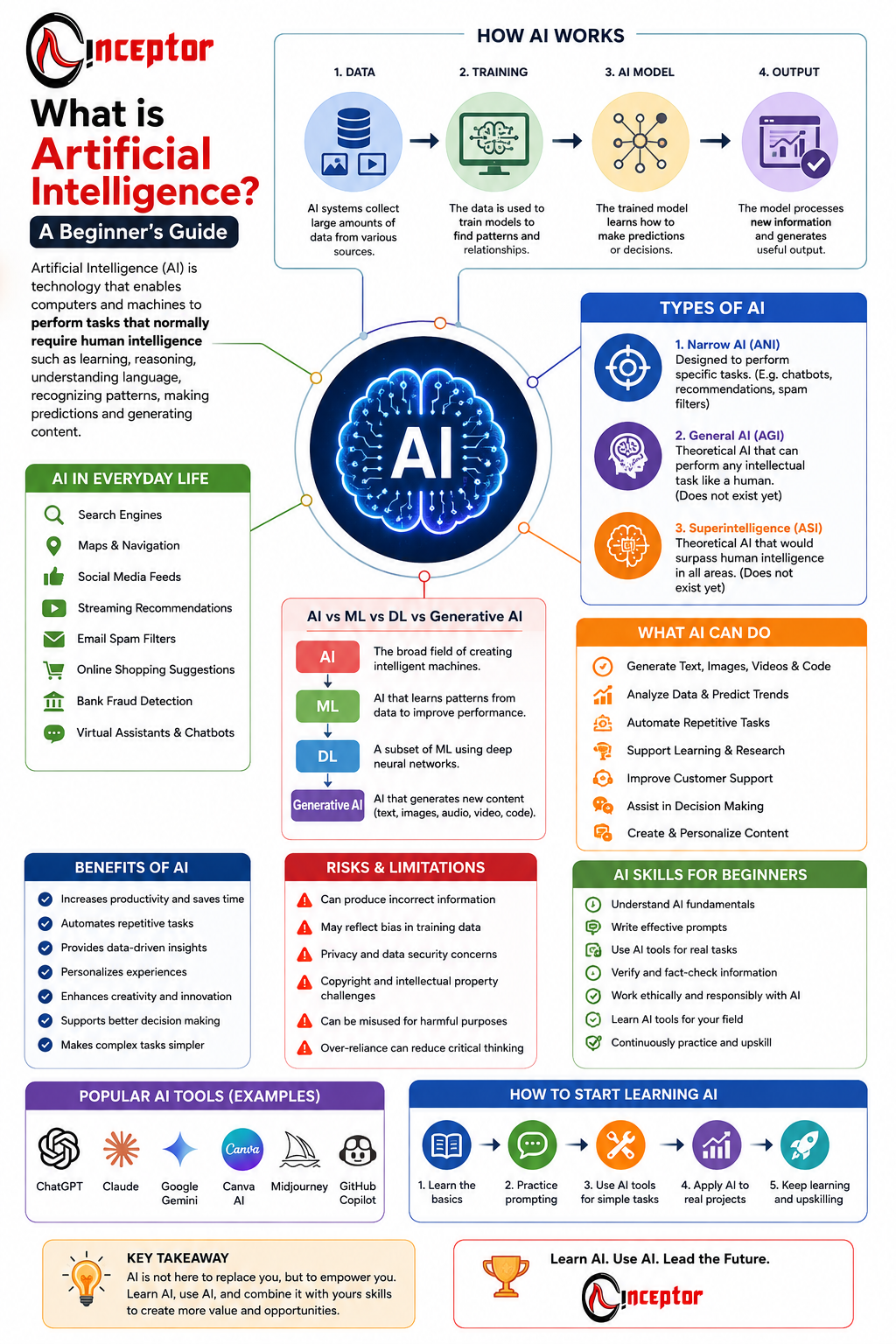
AI may seem complicated, but beginners can understand the basic idea through four components:
Data → Training → AI Model → Output
Imagine you want a computer to identify cats in photographs.
First, the AI system can be trained using many examples of images containing cats and other objects. During training, machine-learning algorithms identify statistical patterns and features in the data. The resulting AI model can then process a new image and estimate whether it contains a cat.
NIST describes an AI model as a component that uses computational, statistical or machine-learning techniques to generate outputs from inputs.
The same general concept can be applied to many tasks.
For example:
| AI Input | AI Task | Possible Output |
| Question | Understand language | Answer |
| Photo | Image recognition | Identify an object |
| Customer data | Pattern analysis | Sales prediction |
| Text prompt | Content generation | Article |
| Voice recording | Speech processing | Transcript |
| Product history | Recommendation | Suggested product |
| Business data | Data analysis | Insights/report |
Modern AI systems can be considerably more sophisticated, but the basic principle remains useful for beginners: AI receives information, processes patterns using a model, and generates an output.
What Is Machine Learning?
Machine learning (ML) is a branch of artificial intelligence that allows computer systems to learn patterns from data and improve their ability to perform particular tasks.
NIST describes machine learning as developing and using computer systems that adapt and learn from data with the goal of improving accuracy.
A useful way to understand the relationship is:
Artificial Intelligence → Machine Learning → Deep Learning → Many modern Generative AI systems
AI is the broader field. Machine learning is one approach to building AI, while deep learning is a specialized form of machine learning based on multilayer neural networks.
What Is Generative AI?
Generative AI is artificial intelligence designed to generate new content based on patterns learned from training data.
It can produce:
- Text
- Images
- Videos
- Audio
- Music
- Computer code
- Presentations
- Designs
- Summaries
- Ideas and other digital content
NIST describes generative AI as a class of AI models capable of generating derived synthetic content, including text, images, audio and video.
Generative AI is one reason AI has become accessible to ordinary users. You no longer necessarily need to be a programmer or data scientist to interact with sophisticated AI systems.
You can simply provide instructions called prompts.
For example:
“Explain digital marketing to me as if I am a complete beginner.”
or:
“Create a 30-day social media marketing plan for a small bakery.”
The AI processes the prompt and generates a response.
What Is an AI Prompt?
An AI prompt is the instruction, question, context, or information you provide to an AI system to tell it what you want.
For example, a weak prompt might be:
“Write about business.”
A more useful prompt could be:
“Write a 1,000-word beginner’s guide explaining how university students can start a small online business with less than KSh 5,000. Include five realistic ideas, estimated costs, potential customers, risks and a 30-day action plan.”
Generally, providing clear context, requirements and desired output makes it easier for an AI assistant to understand your objective.
Learning how to communicate effectively with AI is therefore becoming an important digital skill.
Examples of Artificial Intelligence in Everyday Life
You may already use AI regularly without thinking about it.
Common examples include:
Search engines: AI helps interpret searches and retrieve useful information.
Maps and navigation: Navigation applications can analyse traffic and recommend routes.
Social media: AI helps recommend posts, videos, advertisements and accounts.
Streaming services: Recommendation systems suggest movies, music and other content based on viewing or listening patterns.
Email: AI can help identify spam, suspicious messages and important emails.
Online shopping: Ecommerce platforms use AI-powered recommendation systems to suggest products.
Banking and financial services: AI can assist with fraud detection, credit risk assessment and transaction monitoring.
Customer support: Businesses increasingly use AI chatbots and virtual assistants to answer customer questions.
Education: AI can explain concepts, generate practice questions, summarise material and support personalized learning.
Healthcare: AI has applications ranging from medical-image analysis to research and clinical decision support, although high-stakes decisions still require appropriate professional oversight.
AI therefore extends far beyond chatbots.
What Are the Main Types of Artificial Intelligence?
AI can be classified in several ways, but beginners will often encounter three capability-based concepts.
1. Artificial Narrow Intelligence (ANI)
Artificial Narrow Intelligence refers to AI designed to perform specific tasks or operate within limited domains.
Examples include:
- Recommendation systems
- Spam detection
- Voice recognition
- Image recognition
- Translation systems
- AI chatbots
- Fraud detection systems
Today’s practical AI systems fall within specialized or narrow AI, even when a single system can perform many different tasks.
2. Artificial General Intelligence (AGI)
Artificial General Intelligence generally refers to a hypothetical or future AI capable of performing intellectual tasks broadly at a human-like level rather than being restricted to particular domains.
AGI remains an area of research and debate; it should not be confused with the AI tools currently available.
3. Artificial Superintelligence (ASI)
Artificial Superintelligence is a theoretical concept describing AI that would substantially exceed human intellectual capabilities across many areas.
ASI does not currently exist.
For beginners, the important distinction is that the powerful AI applications available today should not automatically be interpreted as human-like general intelligence.
What Are Large Language Models (LLMs)?
A Large Language Model (LLM) is an AI model trained on very large amounts of text and other data to learn statistical relationships in language.
LLMs power many modern generative AI applications.
They can perform tasks such as:
- Answering questions
- Writing and rewriting
- Summarising documents
- Translating languages
- Brainstorming
- Generating computer code
- Extracting information
- Tutoring
- Analysing text
- Following multi-step instructions
LLMs are particularly important because they allow people to interact with AI using ordinary language rather than traditional computer programming.
AI vs Machine Learning vs Deep Learning vs Generative AI
These terms are related but should not be used interchangeably.
| Technology | Simple Meaning |
| Artificial Intelligence (AI) | Broad field of creating machines capable of intelligent tasks |
| Machine Learning (ML) | AI techniques that learn patterns from data |
| Deep Learning | Machine learning using multilayer neural networks |
| Generative AI | AI capable of generating new content |
| LLM | A model designed for understanding and generating language |
Think of Artificial Intelligence as the large umbrella under which several related technologies exist.
What Can Artificial Intelligence Do?
AI capabilities continue to expand. Depending on the system, AI can help people:
1. Generate Content
AI can assist with creating articles, emails, reports, social-media content, product descriptions, scripts and marketing materials.
2. Create Images and Designs
Generative AI can turn text instructions into illustrations, advertisements, concept art, product images and other visual material.
3. Generate and Edit Video
AI tools can assist with scripts, avatars, voiceovers, captions, translation, editing and video generation.
4. Analyse Data
AI can help users identify patterns, interpret datasets, create summaries and support forecasting.
5. Write Computer Code
AI coding assistants can explain code, generate functions, identify bugs and help developers build software more efficiently.
6. Support Learning
Students can use AI as a study assistant to explain difficult topics, generate quizzes, develop study plans and provide practice exercises.
7. Automate Business Tasks
Businesses can use AI to support customer service, marketing, reporting, document processing, sales workflows and administrative work.
8. Conduct Research
AI can help organise information, identify themes, compare sources and summarise large amounts of material. Important facts should still be checked against reliable primary sources.
What Are the Benefits of Artificial Intelligence?
AI can offer significant advantages when used appropriately.
Productivity: Repetitive or time-consuming knowledge tasks can often be completed faster.
Accessibility: Natural-language interfaces make sophisticated digital capabilities available to more people.
Automation: Businesses can automate parts of workflows and routine processes.
Personalization: AI systems can adapt recommendations, learning materials and experiences to individual users.
Data analysis: AI can identify patterns within volumes of information that would be difficult for humans to process manually.
Creativity: Generative AI can support brainstorming, prototyping and content creation.
Decision support: AI can analyse information and provide predictions or recommendations that humans can incorporate into decisions.
What Are the Risks and Limitations of AI?
AI is powerful, but it is not automatically correct.
Important limitations include:
AI Can Produce Incorrect Information
Generative AI can confidently generate information that is inaccurate or fabricated. Important facts should therefore be verified.
Bias
AI systems can reflect biases present in their training data, design choices or deployment environment.
Privacy
Users should be careful when entering confidential, sensitive or personally identifiable information into AI systems.
Copyright and Intellectual Property
AI-generated content can raise copyright, licensing and ownership questions depending on the system, source material, jurisdiction and intended use.
Cybersecurity
AI can improve security operations, but it can also introduce new attack surfaces and be misused.
Over-Reliance
AI should support human judgment rather than replace critical thinking, particularly in areas such as medicine, law, finance and safety.
NIST’s AI work consequently emphasizes risk management and trustworthy, responsible development and use of AI systems.
Will Artificial Intelligence Replace Jobs?
AI is likely to change many jobs and workflows, but the impact differs significantly between industries and occupations.
Rather than thinking only in terms of entire jobs disappearing, it is useful to think about tasks.
A marketer might use AI to draft content faster. A programmer may use AI to generate or review code. A teacher might generate quizzes and lesson materials. A designer may rapidly develop concepts. A business owner could automate common customer questions.
This creates an important career principle:
Learning how to work effectively with AI may become more valuable than simply trying to compete against AI.
People who combine professional expertise, communication, creativity, judgment and AI skills can potentially use the technology to become more productive.
Do You Need Coding Skills to Learn AI?
No. You do not need programming skills to start learning or using AI.
Beginners can start with everyday applications such as:
- AI chatbots
- AI research assistants
- AI writing tools
- AI image generators
- AI presentation tools
- AI video generators
- AI data-analysis assistants
Coding becomes more important when you want to move into technical areas such as AI engineering, machine learning, data science, model development, APIs and advanced automation.
This means AI has opportunities for both technical and non-technical learners.
What AI Skills Should Beginners Learn?
If you are starting from zero, focus first on practical AI literacy.
A useful learning sequence is:
AI fundamentals → Prompting → AI research → Content creation → Data analysis → AI automation → Specialized AI skills
Important beginner skills include understanding how AI works, writing effective prompts, verifying AI-generated information, using AI responsibly, creating text and visual content, analysing information, and integrating AI into real workflows.
After mastering the basics, learners can specialize in areas such as:
- AI-assisted digital marketing
- AI graphic design
- AI video creation
- Data analytics with AI
- Software development with AI
- AI automation
- AI-powered cybersecurity
- Machine learning
- AI application development
- AI content creation
- AI digital products creation
How Can You Make Money Using AI?
AI itself is not a guaranteed source of income. Its commercial value comes from using it to solve a problem, improve a service or create something customers value.
For example, someone with graphic-design skills can use AI to accelerate concept creation while still applying design judgment.
A digital marketer can use AI for research, content planning, SEO analysis and campaign development.
A programmer can use AI coding assistants to increase development speed.
A subject-matter expert can use AI to help package their knowledge into products such as:
- Ebooks
- Online courses
- Micro-courses
- Templates
- Tutorials
- Workbooks
- Business guides
- Educational resources
- Prompt libraries
The strongest approach is therefore not simply “learn AI.”
It is:
Learn AI + develop a valuable skill + solve a real problem.
How to Start Learning Artificial Intelligence as a Complete Beginner
You do not have to understand advanced mathematics or machine learning before experimenting with AI.
Start by learning basic AI terminology and then use an AI assistant for simple everyday tasks.
For example, ask AI to:
“Explain Excel formulas to me as a beginner and give me five exercises.”
Then progress to more structured prompts:
“Act as my Excel tutor. Create a seven-day beginner learning plan. Give me one lesson and practical exercise each day and test me before moving to the next topic.”
Next, apply AI to an actual project: analyse a spreadsheet, develop a presentation, create a marketing plan, research a business idea, build a simple website or produce learning materials.
Practical use is one of the fastest ways to develop AI literacy.
Frequently Asked Questions About Artificial Intelligence
What does AI stand for?
AI stands for Artificial Intelligence. It refers broadly to technologies that enable computers and machines to perform tasks involving capabilities such as learning, reasoning, prediction, language processing and decision-making.
What is AI in simple words?
AI is technology that allows computers to perform tasks that would normally require aspects of human intelligence.
Is ChatGPT artificial intelligence?
Yes. ChatGPT is an example of a generative AI application built around models capable of processing and generating language.
Is AI the same as ChatGPT?
No. Artificial Intelligence is the broader field. ChatGPT is one application of AI technology.
Is Google artificial intelligence?
Google is a technology company, not an AI itself. However, many Google products and services incorporate artificial intelligence.
Can AI think like humans?
Current AI systems can perform tasks that appear intelligent, but this should not be equated with human consciousness, understanding or general intelligence.
Can beginners learn AI?
Yes. Many modern AI tools use natural-language interfaces, meaning beginners can start using them without programming knowledge.
Do I need mathematics to learn AI?
Not for basic AI literacy or everyday use. Mathematics becomes increasingly important for technical paths such as machine learning engineering, model development and advanced data science.
What is generative AI?
Generative AI is AI designed to create new content such as text, images, audio, video and computer code.
Is AI free to use?
Many AI services provide free or limited-access versions, while advanced models, higher usage limits or business features may require payment.
The Future of Artificial Intelligence
Artificial intelligence is evolving from a specialist technology into a general-purpose layer across software, education, business, science and creative work.
The key question for beginners is therefore becoming less:
“Will AI affect me?”
and increasingly:
“How can I learn to use AI effectively and responsibly?”
The people and organisations positioned to benefit are likely to be those that understand both what AI can do and where its limitations require human judgment.
Conclusion: Start Learning AI Today
Artificial Intelligence does not have to be complicated.
At its simplest, AI is technology that enables computers to perform tasks involving capabilities we associate with intelligence- such as learning from information, recognizing patterns, understanding language, making predictions and generating content.
For a complete beginner, there is no need to start by building machine-learning models.
Start with the fundamentals. Learn how to prompt AI effectively. Experiment with practical tasks. Verify important information. Understand AI’s limitations. Then combine AI with a marketable skill or area of expertise.
AI is best viewed not merely as a tool to ask questions, but as a new layer of digital capability that can help people learn, create, analyse, automate and solve problems.