
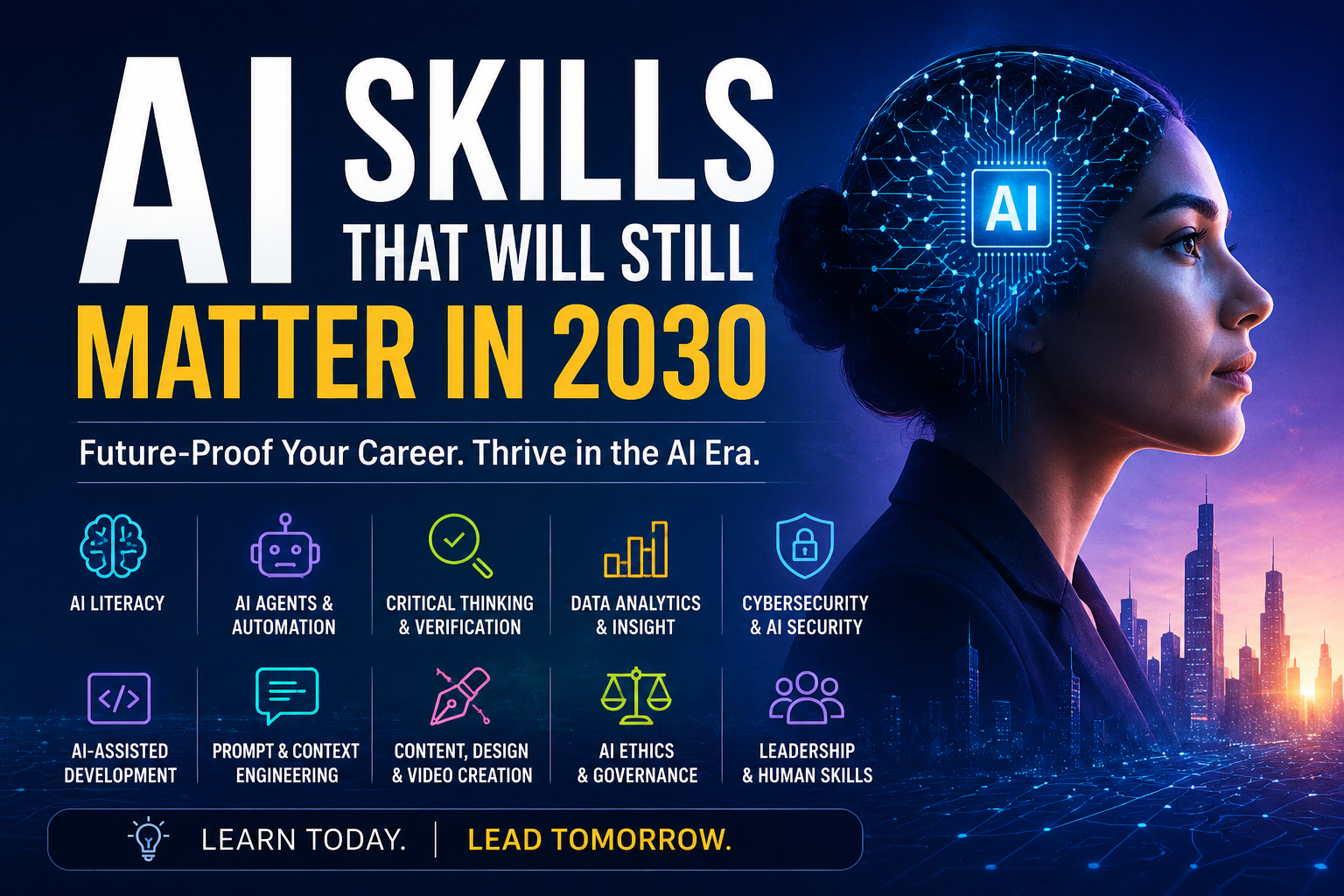
AI Skills That Will Still Matter in 2030: 15 Future-Proof Skills to Learn Today
Artificial intelligence is changing so quickly that a skill that looks impressive today could become a basic feature inside an AI tool within a few years.
So, if you are choosing what to learn now, the better question is not simply:
“Which AI tool should I learn?”
It is:
“Which skills will remain valuable even when AI becomes much more capable?”
That distinction matters.
The World Economic Forum (WEF) estimates that 39% of workers’ existing skill sets will be transformed or become outdated between 2025 and 2030. At the same time, it projects 170 million new jobs and 92 million displaced jobs globally by 2030- a net increase of 78 million. AI and big data, cybersecurity and technological literacy are among the fastest-growing skills, but analytical thinking, creativity, resilience, leadership and collaboration remain important.
LinkedIn goes even further, estimating that 70% of the skills used in most jobs will change by 2030, with AI acting as one of the major catalysts.
The opportunity, therefore, is not to compete against AI at tasks machines can perform cheaply. It is to learn how to use, direct, verify, integrate and commercialize AI.
Here are 15 AI-related skills likely to remain valuable through 2030 and beyond.
1. AI Literacy
AI literacy will become similar to computer literacy or internet literacy today.
You don’t necessarily need to become an AI engineer. But you should understand what AI can do, where it fails and how to use it productively.
AI literacy includes understanding concepts such as generative AI, large language models, multimodal AI, AI agents, hallucinations, context, training data, privacy and automation.
WEF ranks AI and big data as the fastest-growing skill category toward 2030, while technological literacy is also among the top three.
Someone working in accounting, marketing, education, healthcare, agriculture or business may therefore benefit from AI skills even when their profession is not technically an “AI job.”
Potential opportunities: AI-assisted freelancer, AI trainer, AI implementation specialist, AI productivity consultant and AI-enabled entrepreneur.
2. AI Agent Development and Management
One of the biggest transitions between today’s chatbots and the AI workplace of 2030 is likely to be the growth of AI agents.
Instead of simply asking AI a question, people will increasingly assign AI systems goals and workflows.
For example, an agent might:
Research leads → qualify prospects → draft personalized messages → update a CRM → schedule follow-ups → produce a sales report.
Microsoft describes an emerging workplace in which people build, delegate tasks to and manage AI agents. Its 2025 research found that leaders expected teams increasingly to train and manage agents over the following five years.
This makes AI orchestration potentially more durable than expertise in one specific chatbot.
Learn how to design workflows, connect agents with business systems, establish human approval points and evaluate agent performance.
3. Critical Thinking and AI Output Verification
Knowing how to ask AI questions is useful.
Knowing when its answer is wrong is considerably more valuable.
As AI generates more reports, software, advertisements, financial models and recommendations, businesses need people capable of checking the output.
That requires:
AI output → Verify evidence → Challenge assumptions → Apply domain knowledge → Make decision
Microsoft’s 2026 Work Trend Index found that AI users considered quality control of AI output and critical thinking among the most important human capabilities as AI performs more work.
This creates an important principle for 2030:
Don’t outsource your judgment to AI. Use AI to increase the amount and quality of information available to your judgment.
4. Data Analysis and Data Literacy
AI runs on data.
Organizations therefore need people capable of collecting, cleaning, interpreting and communicating data.
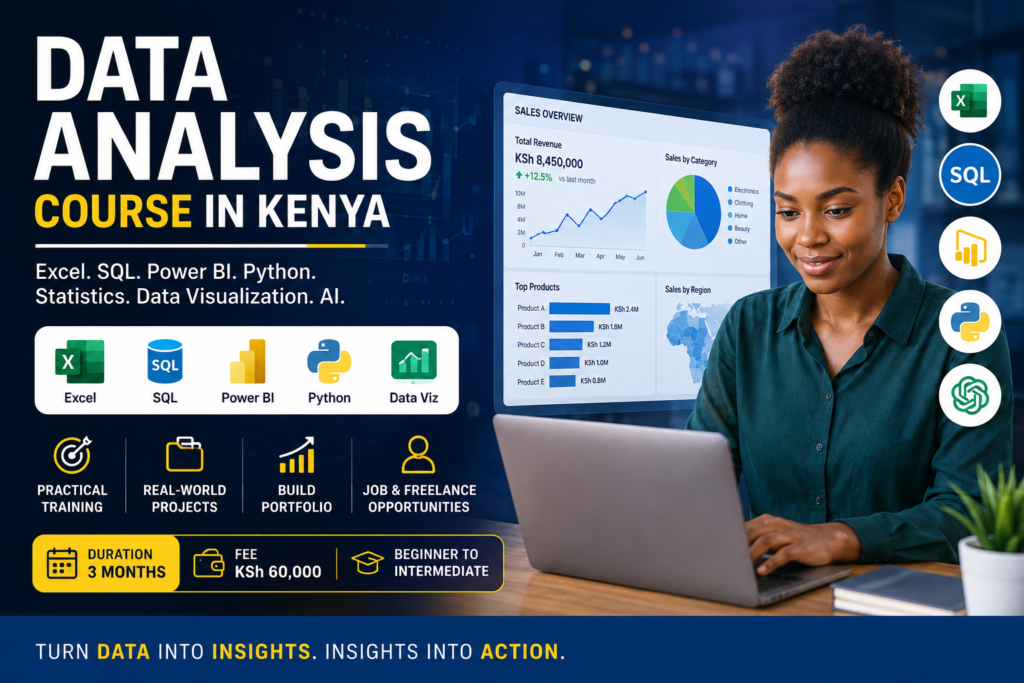
Useful skills include:
- Advanced Excel
- SQL
- Power BI
- Python
- Data visualization
- Statistics
- AI-assisted analytics
- Business intelligence
The important shift is that AI can increasingly perform some technical analysis itself.
The valuable analyst of 2030 may therefore spend less time manually producing charts and more time answering:
What does this data mean?
Why did this happen?
What should the organization do next?
This combination of AI + data + business judgment should remain powerful.
5. Cybersecurity and AI Security
The more organizations digitize and deploy AI, the larger their potential attack surface becomes.
Cybersecurity therefore isn’t becoming obsolete because of AI. AI is creating new security problems alongside new defensive capabilities.

WEF identifies networks and cybersecurity as the second-fastest-growing skill category toward 2030.
Important areas include cloud security, ethical hacking, penetration testing, identity and access management, incident response, AI security, data privacy and securing AI agents.
There will also be demand for people who understand threats unique to AI systems, such as prompt injection, model manipulation and sensitive-data leakage.
6. AI Automation and Workflow Design
Businesses rarely pay simply because someone knows how to use ChatGPT.
They pay for results.
For example:
“I can automate part of your customer-support workflow and reduce response time.”
is commercially stronger than:
“I know how to write ChatGPT prompts.”
This makes workflow automation one of the most practical AI skills to develop.
You might automate:
Customer inquiry → AI categorization → Suggested response → Human approval → CRM update → Follow-up
Or:
Order received → Invoice generated → Customer notified → Inventory updated → Management report
Learning to combine AI with APIs, spreadsheets, databases and automation platforms can create opportunities across thousands of SMEs.
7. Software Development With AI
AI can already generate significant amounts of code. That doesn’t necessarily make software development irrelevant. It changes what developers need to be good at.
Instead of spending most of their time manually producing syntax, developers can increasingly concentrate on requirements, architecture, testing, security, integration and reviewing AI-generated code.
The valuable developer becomes:
Problem → Architecture → AI-assisted development → Testing → Security → Deployment → Improvement
Programming remains on WEF’s skills outlook, but technological change is also increasing the importance of systems thinking, design and related capabilities.
Learning programming with AI, rather than pretending AI does not exist, is therefore the more durable strategy.
8. Prompt Engineering – But Not Prompting Alone
Prompt engineering is useful, but prompting by itself is unlikely to be a durable career moat through 2030.
AI interfaces are becoming better at understanding natural instructions.
The stronger skill is context engineering: giving an AI system the right information, tools, constraints, examples, memory and objectives to complete a task reliably.
Instead of learning:
“100 secret ChatGPT prompts”
learn:
Problem definition → Context → Data → Instructions → Tools → Evaluation → Refinement
That framework can survive changes in individual AI platforms.
9. AI Content Strategy and Digital Marketing
AI can produce articles, images, videos and advertisements at enormous scale.
That creates a paradox.
Content becomes easier to produce- but valuable attention becomes harder to win.

Successful marketers will need more than content-generation skills. They will need audience research, positioning, storytelling, SEO, AI-search optimization, conversion optimization, analytics, distribution and brand strategy.
WEF’s skills outlook also indicates continued relevance for marketing and media skills, while creative thinking is among the capabilities expected to rise in importance.
The winning combination becomes:
Human strategy + AI production + Distribution + Analytics
rather than simply “AI content generation.”
10. AI Video Creation and Editing
Video will continue to be an important format for education, marketing, entertainment, product demonstrations and social media.
AI is making production dramatically easier.
A creator can increasingly move through:
Idea → Script → Voice → Avatar/visuals → Video → Editing → Translation → Distribution

The skill that matters, however, isn’t knowing where a particular “Generate Video” button is located.
Platforms will change.
The durable capabilities are storytelling, scripting, visual communication, editing judgment, audience understanding and the ability to integrate AI throughout the production workflow.
11. AI-Assisted Graphic Design and UX
Graphic designers are among the roles WEF says are being reshaped significantly by generative AI.
That doesn’t mean visual communication disappears.
It means basic production is increasingly automated.
Someone who only knows how to manually remove backgrounds or create simple social-media graphics may face greater competition.
A stronger combination for 2030 is:
Design principles + UX + Brand strategy + AI generation + Human taste
WEF also expects design and user-experience skills to gain importance as technological change continues.
12. AI Ethics, Governance and Responsible AI
As organizations use AI for recruitment, finance, healthcare, education, security and decision-making, questions about accountability become more important.
Who is responsible when an AI system makes a harmful recommendation?
Was the underlying data biased?
Can confidential information be entered into the system?
Should an AI be allowed to make the final decision?
Organizations will need people who understand areas such as AI governance, privacy, transparency, risk assessment, human oversight and regulatory compliance.
This is especially relevant in regulated sectors.
13. Domain Expertise + AI + Digital Business
This may be one of the most underestimated skills strategies for 2030.
You don’t necessarily need to abandon your profession and become an AI engineer.
Instead, combine your existing expertise with AI.

For example:
Teacher + AI = AI-enabled education specialist
Accountant + AI = AI-enabled financial analyst
Marketer + AI = AI growth strategist
Lawyer + AI = Legal AI specialist
Farmer/agronomist + AI = AI-enabled agribusiness consultant
Cybersecurity professional + AI = AI security specialist
HR professional + AI = AI-enabled talent specialist
The ILO’s research suggests the larger near-term story is job transformation rather than wholesale job elimination, because occupations consist of many different tasks and AI exposure does not automatically mean an entire occupation can be automated.
Domain expertise gives you something AI alone lacks: context.
14. Creativity, Communication and Leadership
Paradoxically, the growth of AI could make some deeply human capabilities more valuable.
WEF expects skills such as creative thinking, resilience, flexibility, agility, curiosity, leadership and social influence to continue rising in importance toward 2030.
AI may generate 50 business ideas – A human still has to decide which opportunity makes sense.
AI may draft a presentation – A leader still has to persuade people to act.
AI may analyze customer complaints – A manager still needs empathy and judgment when handling the customer.
Therefore, don’t build only technical AI skills.
Build human skills amplified by AI.
15. Continuous Learning and Adaptability
Perhaps the most future-proof skill is the ability to learn new skills quickly.
The AI platform you use today may not be the dominant platform in 2030.
Specific interfaces will change.
Models will change.
Jobs will change.
Business models will change.
WEF explicitly identifies curiosity and lifelong learning among the skills expected to rise in importance through 2030.
Don’t build your career around knowing one tool.
Build it around your ability to solve problems using whichever tools become available.
Which AI Skills Should You Learn First?
If you are starting from zero, don’t attempt to learn everything simultaneously.
A practical pathway is:
| Level | Skills to Learn |
| Beginner | AI literacy, prompting, research, AI productivity |
| Income-ready | AI digital product creation, digital marketing, graphic design, video creation |
| Intermediate | Data analytics, automation, AI agents |
| Technical | Programming, APIs, cybersecurity, machine learning |
| Professional | AI strategy, governance, implementation, consulting |
| Leadership | AI decision-making, human-agent management, business transformation |
The objective isn’t to collect certificates.
It is to become capable of solving real problems with AI.
Can You Make Money With These AI Skills?
Yes- but the skill itself is only part of the equation.
A useful way to think about AI income is:
Skill + Problem + Customer + Deliverable = Opportunity
For example, suppose you learn AI video creation.
Instead of saying:
“I know AI video generation.”
package the skill into something somebody can buy:
“I create 10 short promotional videos per month for small businesses.”
The same principle applies to other skills.
A data analyst can sell dashboards.
A cybersecurity specialist can offer security assessments.
A designer can sell templates.
A developer can build applications.
An AI trainer can create and sell tutorials and online courses.
An automation specialist can implement workflows.
A knowledgeable professional can package expertise into ebooks, templates, video tutorials, prompt systems, micro-courses and other digital products.
This is important because the future of AI work will include not only employment, but also freelancing, consulting, entrepreneurship and digital-product businesses.
The Skills Most at Risk of Becoming Commoditized
Not every AI skill being promoted today will remain equally valuable.
Be cautious about building an entire career around:
basic prompting, basic AI image generation, generic AI article writing, simple transcription, elementary data entry, basic background removal, generic social-media graphics or knowing one AI platform.
These aren’t necessarily useless.
The problem is that as AI products improve, these capabilities increasingly become features rather than professions.
The safer strategy is to move one level higher.
Don’t just generate an image.
Understand branding and visual communication.
Don’t just generate an article.
Understand audience, SEO, AI search, persuasion and conversion.
Don’t just ask AI questions.
Know how to verify the answers.
Don’t just use an AI agent.
Know how to design, supervise and improve the workflow.
The Best AI Skill Combination for 2030
There probably won’t be one single “best AI skill.”
The strongest workers and entrepreneurs are more likely to combine several capabilities:
AI + Human Judgment + Domain Expertise + Business Skills + Digital Product Creation
For example:
AI + Cybersecurity + Communication
AI + Data Analytics + Business Strategy
AI + Programming + Entrepreneurship
AI + Marketing + Psychology
AI + Teaching + Digital Products
AI + Design + Branding
AI + Accounting + Financial Analysis
This is harder for automation to replace because the person’s value doesn’t depend on executing one repetitive task.
Frequently Asked Questions
What AI skills will be most valuable by 2030?
AI and big data, cybersecurity, technological literacy, AI automation and agents, data analytics, AI-assisted software development and AI governance are strong candidates. Human capabilities including analytical thinking, creativity, leadership, resilience and collaboration are also expected to remain important.
Is AI worth learning for the future?
Yes. LinkedIn estimates that 70% of skills used in most jobs could change by 2030, with AI acting as a major catalyst. The goal, however, should be practical AI literacy and problem solving – not simply memorizing today’s tools.
Will AI replace programmers?
AI will automate increasing portions of coding, but software work also involves requirements, architecture, testing, security, integration and decision-making. The more defensible skill is therefore software development with AI, rather than competing with AI at writing routine code.
What is the easiest AI skill for beginners?
Start with AI literacy, research, prompting and AI-assisted productivity. Then choose a specialization such as digital marketing, design, video, data analytics, programming or automation.
Do I need coding skills to work with AI?
No. Many valuable applications of AI require little or no programming. Coding becomes more important if you want to build applications, advanced automations, integrations, agents or machine-learning systems.
Will prompt engineering still be valuable in 2030?
Prompting will remain useful, but basic prompt writing alone is unlikely to provide a strong competitive advantage. Context engineering, workflow design, AI evaluation and agent orchestration are more durable skills.
Final Takeaway: Don’t Learn to Compete With AI – Learn to Work Above It
The biggest mistake you can make is trying to predict which individual AI tool will dominate in 2030.
Tools change too quickly.
Instead, develop capabilities that become more valuable as AI becomes more powerful.
Learn digital entrepreneurship with AI.
Learn to define problems.
Learn to analyze data.
Learn to verify AI outputs.
Learn to automate workflows.
Learn to manage AI agents.
Develop domain expertise.
Learn cybersecurity.
Learn to communicate and sell.
And above all, keep learning.
Microsoft’s 2026 research captures this transition well: as AI expands what individuals can accomplish, the premium increasingly moves toward judgment, clarity of intent and designing the work itself.
That may ultimately be the most important AI skill of 2030:
Knowing what should be done, then knowing how to make humans and AI work together to accomplish it.